
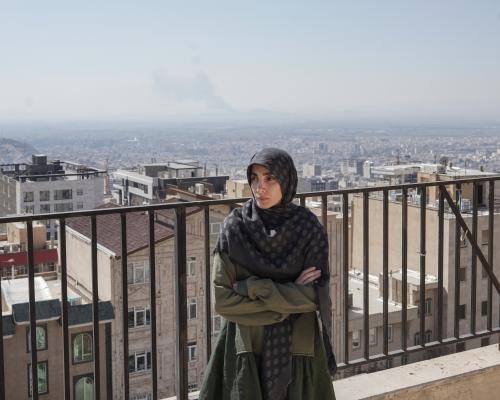
As the US-Israeli military campaign enters its third week, approximately 3.2 million Iranians have been temporarily displaced according to the UN's refugee agency. The conflict has forced many to flee urban centers like Tehran for rural areas, yet countless others remain in their homes, grappling with the realities of constant airstrikes.
Nafise, a 30-year-old jewelry designer living in Tehran, describes her daily life amid the onslaught of violence. "We don't want this war. We want change, but not like this," she says, reflecting the sentiments of many who are caught between their desire for political reform and the fear of escalating conflict. Her business, once thriving, has been stymied first by internet shutdowns during anti-government protests in January and now by warfare. Originally reported by The Guardian.
Nafise and her husband, Farhad, have transformed their apartment into a cozy refuge filled with memories of family trips and Persian rugs. However, the calming atmosphere is disrupted by the ominous sounds of explosions reverberating through the city. The couple briefly evacuated Tehran last summer after Israel targeted Iranian military and nuclear sites but chose to stay this time, fearing for the safety of their cats, Sam and Yal.
Evenings are now spent socializing with friends, offering a small solace in these turbulent times. "Every night at eight, we gather at someone's house. Everyone brings food or dessert to share. It helps keep the spirits up," Nafise explains. Amid the chaos, she expresses hope for the future, longing for a regime change without reverting to the previous monarchy-a sentiment echoed by many in her circle.
Daily Life Disrupted by War
The ongoing airstrikes have fundamentally altered the everyday lives of Tehran residents. Schools have closed, and businesses are shuttered, caught in the crossfire of international tensions. Amir, a 40-year-old shop owner who travels daily from Karaj to Tehran, voices his concerns about the prolonged conflict. "The war and economic conditions directly affect my work," he remarks. His business distributing brake pads is struggling under the pressure of uncertainty.
His colleague Abbas Agha shares similar apprehensions. Both men are worried about the economic ramifications of sustained hostilities. "If sanctions were lifted, the country could make significant progress. Our economy holds great potential," Amir notes, highlighting the desperate hope for a resolution that could revitalize everyday life.
As of now, at least 1,444 people have lost their lives in Iran, with nearly 19,000 more wounded, according to the state news agency. The dire humanitarian situation is exacerbated by a lack of international cooperation, as the war has led to oil prices surging over $100 a barrel after Iran effectively closed the Strait of Hormuz to the US and its allies.
International Reactions and Ramifications
The conflict has not only affected the lives of ordinary Iranians but has also exposed deep divisions within NATO. While the UK and European governments are wary of becoming embroiled in the war, the US has been engaged in retaliatory strikes against Iranian targets in the region. Recently, a direct communications channel was reactivated between US special envoy Steve Witkoff and Iran's foreign minister, Abbas Araghchi, sparking hopes for diplomatic resolutions amid the chaos.
Vincent Cassard, head of the International Committee of the Red Cross in Tehran, emphasizes the profound impact the conflict has had on civilians. "I am seeing the heavy strain that the recent escalation of hostilities has placed on people in Iran, who fear for their lives, the safety of their loved ones, and their livelihoods," he stated. The loss of life and damage to civilian infrastructure has raised alarms among humanitarian organizations.
Hope Amidst Despair
Despite the mayhem surrounding them, many Iranians remain resilient, clinging to hope for a better future. Nafise's words resonate deeply: "Even if it changes one day, it won't happen overnight, and it won't happen with this war." This sentiment encapsulates the struggle between the desire for immediate reform and the recognition that lasting change requires time and stability.
As the conflict continues, the psychological toll on the populace mounts. Daily routines have been upended, with families forced to adapt to a new normal that includes constant vigilance against airstrikes. The resilience of the Iranian people is tested, yet their resolve to seek a different future remains unbroken.
In the face of adversity, Iranians like Nafise and Amir continue to navigate a precarious existence, balancing hope and despair while yearning for a peaceful resolution to the ongoing crisis.
Originally reported by The Guardian. View original.