
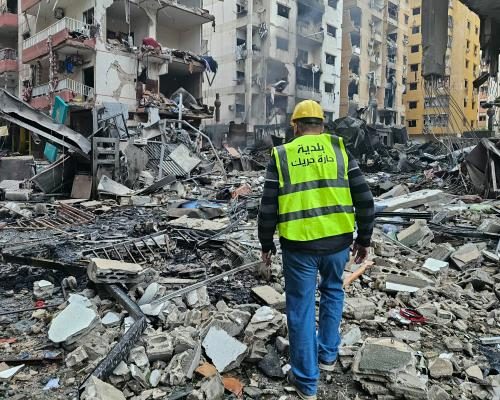
Israel's recent announcement of an expanded ground campaign in southern Lebanon has intensified fears of a prolonged military occupation among the hundreds of thousands of displaced Lebanese. The escalation was underscored by remarks from Israel's defense minister, Israel Katz, who indicated that displaced Lebanese would not be permitted to return home until the safety of Israeli citizens near the border was assured. This statement has raised alarms regarding the potential for a long-term Israeli military presence in the region.
Displacement and Humanitarian Concerns Grow
As the conflict escalates, the humanitarian situation has become dire for those affected. Katz stated, "Hundreds of thousands of Shi'ite residents of southern Lebanon who have evacuated or are evacuating their homes in southern Lebanon and Beirut will not return to areas south of the Litani line until the safety of northern residents is ensured." His comments echo sentiments regarding the situation in Gaza, hinting at a sustained military effort in Lebanon similar to that seen in past conflicts. Since the resurgence of hostilities on March 2, when Hezbollah launched rocket attacks on Israel, the Israel Defense Forces (IDF) have executed a campaign across Lebanese territory, leading to the displacement of approximately 1 million people. Originally reported by The Guardian.
Reports indicate that over 800 individuals have been killed since the conflict intensified, with figures ranging from 826 to over 850. This has caused widespread fear and uncertainty among those displaced, many of whom find themselves without adequate shelter or resources. Ramzi Kaiss, a Lebanon researcher for Human Rights Watch, warned that Katz's statements could lead to forced displacement, a violation of international law. He stated, "Preventing civilians from returning to their homes in an area that is nearly 10% of Lebanon's territory, until some vague 'safety' standard is secured, would be unlawful and further raises the risk of forced displacement, which would be a war crime."
Historical Echoes of Occupation
The prospect of a renewed occupation brings back painful memories for many residents who experienced Israeli military control from 1982 to 2000. Abbas Awadeh, a member of the municipality of Naqoura, expressed the fears of many, noting, "God forbid we return to the days of the previous border-strip occupation. We're afraid of that, honestly. It took us years before we were able to return to Naqoura. To return to that would be very difficult." The beach resort town of Naqoura has been largely deserted following an order for residents to evacuate last week, highlighting the urgency of the situation.
On March 4, the IDF ordered all residents south of the Litani River to temporarily relocate north ahead of planned strikes on Hezbollah targets. This directive was followed by additional displacement orders, further deepening the crisis. Many displaced residents are now sleeping on the streets, struggling to secure basic necessities. Awadeh lamented, "People really want to return to their towns, because the situation is very difficult. Sometimes a person can't even secure food. Displacement is humiliating."
Calls for Military Action Intensify in Israel
The political climate in Israel is also shifting, with far-right officials within the governing coalition advocating for increased military action against Hezbollah. Finance Minister Bezalel Smotrich has suggested that the southern suburbs of Beirut could face destruction akin to that witnessed in Khan Younis during the conflict with Hamas. This rhetoric signifies a potential escalation in military strategy, with calls for the establishment of a security buffer zone inside southern Lebanon gaining traction.
Prof. Yagil Levy, head of the Open University Institute for the Study of Civil-Military Relations in Israel, described the ground operation in southern Lebanon as part of Israel's new security doctrine following the events of October 7. He stated, "It is unfolding the renewed occupation of parts of southern Lebanon. Yet Israel is not returning to the years 1982-2000, when it occupied part of Lebanon but was dragged into a guerrilla war whose casualties forced it to withdraw." Levy explained that the current strategy involves seizing territory while minimizing the risks associated with guerrilla warfare.
International Implications and Future Prospects
With the situation continuing to evolve, Israel's approach to southern Lebanon raises questions about international responses. As the conflict escalates, the United States and other global powers are closely monitoring the developments, particularly with respect to humanitarian conditions. Observers are wary of the implications for regional stability and the potential for further escalation. The evolving security doctrine may also challenge existing ceasefire agreements, complicating prospects for peace.
As fears of a prolonged occupation take hold, the plight of displaced Lebanese remains paramount. The international community may need to intervene to address the humanitarian crisis and ensure the protection of civilians. The coming days and weeks will be crucial in determining the course of this conflict and its impact on the lives of those affected.
Originally reported by The Guardian. View original.