
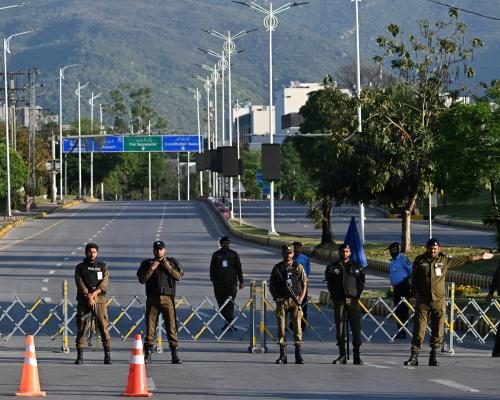
Islamabad, the capital of Pakistan, has been plunged into an unprecedented lockdown as the city braces for high-stakes negotiations between the United States and Iran. Streets that are usually bustling with life have been eerily silent for days, with shopkeepers forced to shutter their businesses and public transport coming to a standstill. Government officials and corporate employees have been ordered to work from home, while daily wage laborers face the grim reality of being deprived of their livelihoods. The only figures visible on the streets are soldiers and police officers, creating a somber atmosphere reminiscent of the pandemic lockdowns. Yet, this current situation is not due to a health crisis, but rather the stringent security measures surrounding the anticipated talks that could potentially reshape the geopolitical landscape of the Middle East.
Frustration Mounts Amidst Extended Restrictions
As the lockdown drags on, frustration among Islamabad's residents is growing. Many laborers, who often live in shared accommodations, were abruptly evicted from their hostels following a government order last Saturday. This sudden displacement has left thousands scrambling to find temporary housing. Areej Akthar, a health officer at the Pakistan Institute of Medical Sciences, described the chaos of the day: "Saturday was chaotic. I am lucky enough that my village is a three-hour drive away. But many people [who] were from distant cities and province[s] had to beg their colleagues, friends and relatives to allow them to stay until the US-Iran negotiations took place." The continuous delays in the promised talks have only heightened anxiety in the city. Originally reported by The Guardian.
Akthar expressed her concern about the lockdown's impact on her ability to perform essential work. "It is like we are living in a cage. We can't go back to work. Many like me can't afford to rent a flat, that's why we live in hostels." With public transport shut down, the challenges only compound for those trying to navigate daily life under these restrictions.
Economic Hardship Deepens for Daily Wage Workers
Beyond the immediate effects of the lockdown, the broader economic repercussions of the ongoing crisis are becoming increasingly severe. The energy crisis, exacerbated by the conflict between the US and Iran, has left many Pakistani citizens struggling to make ends meet. Since the escalation of hostilities in late February, power cuts lasting up to seven hours have become commonplace due to fuel shortages. Muhammad Zubair, a 45-year-old daily wage laborer, lamented his inability to find work over the past six days. Sitting on the pavement, he said, "A lockdown means no work and no work means no food. The government does not care about the poor. We need work to feed our children." His frustration reflects a growing sentiment among daily wage workers who rely on consistent employment to support their families.
The situation is dire for many in the capital. Restaurants that once provided a vital service have had to close their doors due to a lack of cooking gas, while taxi drivers report a staggering 50% drop in earnings. The economic strain has become a heavy burden for those who were already vulnerable.
Impact on Civil Servants and Students
The lockdown has also disrupted the lives of civil servant candidates who were preparing for important exams. The government announced that exams for over 1,200 candidates would be moved to Lahore, a city more than 230 miles away. Yasir Mushtaq, one of the affected candidates, voiced his concerns about the financial strain the relocation would cause. "I have to borrow money," he explained. "It is worse for female candidates. Many females can't travel alone without parents accompanying them. Some are thinking of skipping their exams." This disruption serves as another example of how the lockdown is affecting not just daily laborers but also those pursuing career advancements.
A Nation in Stasis
A senior government official commented on the atmosphere of uncertainty enveloping the nation, stating that it feels as if the entire country has ground to a halt while waiting for decisions in Washington and Tehran. "We are all under a lockdown and it feels like we are back to coronavirus days," they remarked. As Islamabad remains in limbo, residents are left to grapple with the challenges of an extended lockdown while hoping for a resolution that will allow them to return to their normal lives.
With each passing day, the frustration and economic hardship grow more palpable. The residents of Islamabad are left to wonder how much longer they will be confined to their homes and deprived of their livelihoods as they await the outcome of talks that carry significant implications for not just their city, but the region as a whole.
Originally reported by The Guardian. View original.