
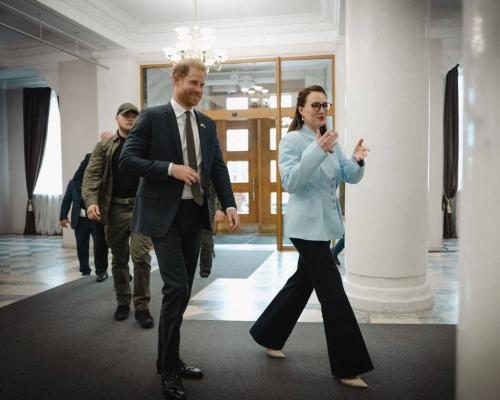
Former President Donald Trump has pushed back against Prince Harry's recent comments urging the United States to fulfill its commitments regarding the ongoing conflict in Ukraine. Trump asserted that the Duke of Sussex does not speak for the UK, emphasizing his own perspective on the matter during a reaction to Harry's speech at the Kyiv Security Forum on Thursday.
Harry, an ex-serviceman, addressed the forum not as a politician but as a soldier and humanitarian, emphasizing the critical role of the United States in global security. He reminded attendees that when Ukraine relinquished its nuclear arsenal, it was under the assurance that its sovereignty would be protected, a promise that the U.S. must honor. "The United States has a singular role in this story," Harry said, pointing out the importance of American leadership in supporting Ukraine during this pivotal moment. "This is a moment for American leadership, a moment for America, to show that it can honor its international treaty obligations - not out of charity but out of its own enduring role in global security and strategic stability." Originally reported by The Guardian.
Trump's Rejoinder to Harry's Advocacy
In response to Harry's impassioned plea, Trump stated, "I think I am speaking for the UK more than Prince Harry.. But I appreciate his advice very much." His remarks came as tensions remain high amid the ongoing Russian invasion of Ukraine, which has resulted in widespread devastation. Trump's comments highlight a broader discussion about the role of prominent figures in advocating for international issues, particularly conflicts that involve significant geopolitical stakes.
Harry's speech aimed to galvanize support and called for a reassessment of commitments made to Ukraine following its disarmament. His background as a soldier lends weight to his arguments, as he understands the complexities of military and humanitarian service. In his address, he spoke passionately about the need for the U.S. to demonstrate its commitment to international treaties and support Ukraine in its struggle against Russian aggression.
Advancements in Ukrainian Drone Technology
Meanwhile, Ukraine continues to innovate in its military strategy, with reports emerging of a Ukrainian MP, Marian Zablotskiy, piloting a drone interceptor from thousands of kilometers away. This groundbreaking demonstration showcased the effectiveness of remote-controlled drone technology, which could play a crucial role in future military engagements. Zablotskiy described the experience as a "historic experiment," successfully operating the drone from his office and from abroad, nearly 2,000 kilometers from the drone's physical location.
Mykhailo Fedorov, Ukraine's defense minister, praised this achievement, stating, "Ukraine is the first in the world to systematically scale up remote control of interceptor drones. Today, we have confirmed results - the downing of targets at distances of hundreds and thousands of kilometers." This advancement could significantly bolster Ukraine's defensive capabilities as it faces ongoing threats from Russian military forces.
Ongoing Conflict and Humanitarian Crisis
The conflict continues to exact a heavy toll on both sides, as Russia struggles to extinguish a massive fire at an oil terminal in Tuapse, which was struck by Ukrainian forces earlier this week. The attack on the oil facilities has resulted in a significant blaze, with local authorities reporting that four storage tanks are ablaze. Residents have been advised to remain indoors to avoid inhaling smoke from the fire, which has created hazardous conditions in the area.
In the midst of these developments, the European Union has made strides in its support for Ukraine, finalizing a €90 billion (£78 billion) loan agreement along with a 20th Sanctions Package aimed at Russia. Ursula von der Leyen, president of the European Commission, announced that the first payment of €45 billion planned for 2026 could be disbursed within this quarter, emphasizing that it would fund domestic drone production in Ukraine, described as "drones from Ukraine for Ukraine." This financial backing underscores the EU's commitment to supporting Ukraine during its ongoing struggle.
As the situation continues to evolve, the human cost of the conflict remains a pressing issue. Recent reports indicate that Russian attacks on residential areas have resulted in casualties, with three individuals killed and at least ten others injured, including children aged nine and fourteen. The ongoing violence highlights the urgent need for diplomatic resolutions and humanitarian assistance as the conflict rages on.
As leaders across the globe engage in discussions on how best to support Ukraine, the call for accountability and action resonates louder than ever. The intersection of politics, military advancements, and humanitarian efforts presents a complex landscape that will require cooperation and commitment from all involved parties.
Originally reported by The Guardian. View original.