
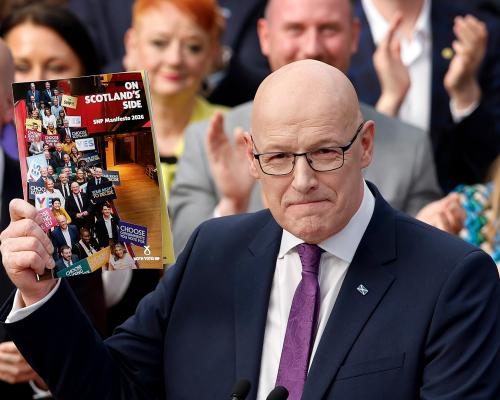
In a bold move ahead of Scotland's parliamentary elections, the Scottish National Party (SNP) has pledged to cap prices for essential grocery items, including bread and milk. John Swinney, the party leader, emphasized that tackling the rising cost of living is "the defining issue of this election." With polls suggesting a significant lead for the SNP, Swinney's commitment to price regulation aims to combat increasing food costs that he claims are affecting the nutritional health of the nation.
At the launch of the SNP manifesto in Glasgow, Swinney outlined plans to fix prices on a range of 20 to 50 essential items, such as cheese, eggs, rice, and chicken. The proposed measures would utilize the party's devolved powers over public health to implement these caps. Swinney argued that the escalating costs directly impact families across Scotland and necessitate immediate government intervention. Originally reported by The Guardian.
Concerns from Retailers and Legal Implications
While the pledge to cap prices has drawn attention, it has also faced swift criticism from the retail sector. Ewan MacDonald-Russell, deputy head of the Scottish Retail Consortium, described the proposal as a "potty gimmick." He highlighted that supermarkets in Scotland already incur significantly higher operational costs, with an estimated £162 million more in expenses compared to their counterparts in England over the next three years. MacDonald-Russell urged the SNP to focus on reducing retailers' costs instead of introducing outdated price controls.
Furthermore, implementing such price caps raises potential legal issues, as it may conflict with the Scotland Act of 1998, which governs the powers of the devolved Scottish Parliament. Concerns have been raised that these price controls could disadvantage smaller shops, and questions linger about whether supermarket discounts would lead to lower prices paid to farmers.
Additional Cost of Living Initiatives
During the manifesto launch, Swinney also announced a £2 cap on bus fares for single journeys across Scotland, a measure expected to cost the government £210 million by 2032. The SNP's commitment to public transport contrasts with proposals from the Scottish Greens, who advocate for universal free bus travel. Last year, the SNP rejected a similar free travel proposal during budget negotiations, drawing criticism from opposition parties.
Swinney further claimed that an independent Scotland would be better positioned to manage energy prices, suggesting that reducing bills would be a key issue in the upcoming election. However, he did not provide specific policies to achieve this goal, which energy experts warn could be challenging given the current reliance on gas in the energy market. In contrast, Labour has emphasized a transition toward renewable energy and nuclear power as the most effective means to lower energy costs for households.
Long-Term Plans and Economic Viability
As the SNP seeks to secure a fifth term in Holyrood, Swinney positioned himself as the candidate of experienced and principled leadership. He reiterated his commitment to avoid increasing income tax bands or rates in the next parliamentary session, countering claims from the Conservative Party and Reform that the current system is overly punitive.
The SNP's manifesto, which is projected to cost an additional £1.4 billion by 2032, includes ambitious plans for building 110,000 affordable homes, with 10% designated for rural areas and islands. This initiative aims to tap into an estimated £20 billion of investable pension fund assets in Scotland. Additional proposals feature a minimum income for artists, reflecting a scheme put forth by Labour, as well as a national ban on mobile phones in classrooms and a "welcome to school" bag for all Year 1 pupils.
However, experts from the Institute for Fiscal Studies have raised concerns over the financial viability of the SNP's proposals. David Phillips, an IFS expert on devolved government spending, pointed out the lack of a credible plan to fund these initiatives. He noted that substantial public sector efficiencies have already been accounted for in existing policies, indicating that fulfilling these new pledges may require further tax increases or deeper cuts to less critical spending areas.
As the election approaches, the SNP's ambitious manifesto will be scrutinized against the backdrop of economic realities, leaving voters to consider whether the proposed measures can be effectively implemented without compromising Scotland's financial stability.Originally reported by The Guardian. View original.