
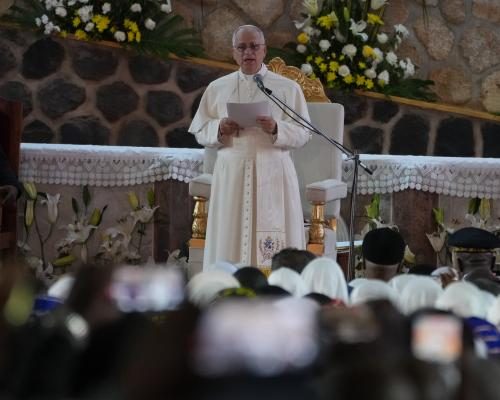
Pope Leo XIV delivered a powerful address in Cameroon, condemning global leaders who misuse religion to justify violence, highlighting the escalating tensions surrounding the U.S.-Israel conflict in Iran. His remarks come amid a tense exchange with the Trump Administration, particularly following his vocal criticism of the ongoing war.
Pope's Stark Warning Against Tyranny
In a speech at Saint Joseph Cathedral in Bamenda, Pope Leo XIV asserted that the world is being "ravaged by a handful of tyrants" who prioritize military spending over humanitarian needs. The pontiff's comments come as he continues an 11-day tour of Africa and reflect a broader concern about the misuse of faith by political leaders. Although he refrained from naming Donald Trump, the implications of his critique were clear, especially given the context of the U.S.-Israel war on Iran. "Woe to those who manipulate religion and the very name of God for their own military, economic and political gain, dragging that which is sacred into darkness and filth," the Pope declared. He emphasized the absurdity of spending billions on war while neglecting essential resources for education and healing. Originally reported by The Guardian.
Support from U.S. Bishops Amid Political Backlash
The Pope's remarks were met with strong support from U.S. bishops, who rallied behind him as tensions with the Trump administration escalated. JD Vance, Trump's vice-president, had previously criticized the Pope for his stance against the Iran war, suggesting that the pontiff should avoid discussions of politics. Vance questioned Leo's interpretation of just war theory, a long-standing Catholic doctrine that justifies military action under specific conditions. However, U.S. bishops quickly countered Vance's claims, asserting that the Pope's position aligns with the Church's teachings on just war. "For over a thousand years, the Catholic Church has taught just war theory," said James Massa, chair of the conference's committee on doctrine. He clarified that legitimate warfare must be in self-defense and that the Pope's comments reflect this tradition.
Pope's Stance on War and Peace
As tensions simmer, Pope Leo XIV reiterated his commitment to peace and dialogue, distancing himself from political debates. "I do not see my role as that of a politician. I am not a politician and I do not want to enter a debate with him," he said. The Pope has consistently advocated for multilateralism and peaceful resolutions to conflicts, emphasizing that true leadership should prioritize healing over warfare. His strong stance against the Iran conflict has attracted both praise and criticism, particularly from those aligned with Trump's administration. The Pope's commitment to non-violence reflects a broader call for global leaders to prioritize diplomacy over military action.
Political Fallout and Charity Funding Cuts
In a separate but related development, the Trump administration appears to be retaliating against the Catholic Church following the Pope's criticism. Reports indicate that the White House has terminated a longstanding $11 million contract with Catholic Charities of the Archdiocese of Miami, which provides crucial services for unaccompanied migrant children. Archbishop Thomas Wenski expressed his dismay at the abrupt decision, pointing out that the program has been a model of excellence in child welfare for over 60 years. "The US government has abruptly decided to end more than 60 years of relationship.. and [the services] will be forced to shut down within three months," Wenski stated. The move has raised concerns about the treatment of vulnerable populations and the impact of political decisions on humanitarian efforts.
The escalating tensions between the Pope and the Trump administration highlight a significant rift in perspectives on leadership, morality, and the role of religion in politics. As the situation unfolds, it remains to be seen how both the Catholic Church and the U.S. government will navigate this complex landscape. Pope Leo XIV's resolute stance against tyranny and war resonates with many as a clarion call for compassion and justice in a world increasingly marked by conflict.
Originally reported by The Guardian. View original.