
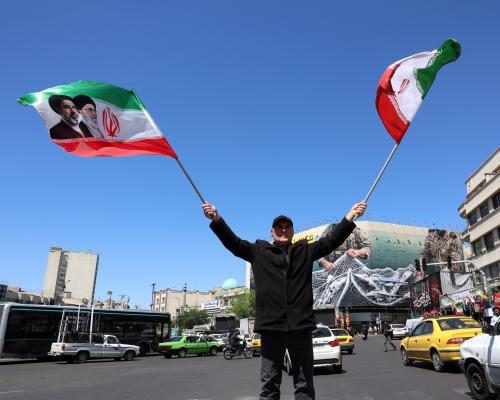
Former President Donald Trump recently asserted that the Iranian Leadership is deeply fragmented, suggesting that internal conflicts have left citizens unaware of who truly leads the nation. However, analysts are pushing back against this characterization, arguing that Iran demonstrates a surprising degree of institutional unity, especially considering the recent spate of high-profile assassinations of senior officials.
Trump's Claims of a Divided Leadership
Trump's remarks about the Iranian leadership's supposed chaos are not new; he has repeated similar claims multiple times in just a few days. He described the situation as a "CRAZY" split between moderates and hardliners, implying that military hardliners have usurped control from civilian leaders. Yet, many experts are skeptical. They point to Iran's ability to maintain its military and political functions despite the assassination of key figures as evidence of a robust system. Originally reported by The Guardian.
Experts argue that Trump's narrative might be more about psychological warfare than an accurate depiction of the Iranian political landscape. Mohamed Amersi, a member of the Global Advisory Council at the Wilson Centre, suggested that Trump's rhetoric aims to create a sense of paralysis within Iran's decision-making processes.
Institutional Cohesion Despite Assassinations
Despite the turmoil from assassinations, including prominent military commanders, Iran's political structure has remained largely intact. Ali Ansari, a professor at St Andrews, indicated that the newly appointed supreme leader, Mojtaba Khamenei, is still consolidating his authority. This transition mirrors the lengthy process experienced by his father, Ali Khamenei, who took years to establish his power. Ansari remarked, "We are not quite sure if he is all there and even if he is all there, whether he will be able to consolidate his position and authority in the way that his father did."
Ali Alfoneh, a senior fellow at the Arab Gulf States Institute, noted that Iran has been moving toward a more collective style of leadership, particularly as the former supreme leader's health declined. As a result, the governance system is adapting, allowing for a more resilient political structure capable of responding to external pressures.
New Strategies Emerge from Conflict
Hassan Ahmadian, an associate professor at the University of Tehran, strongly refuted claims of fractured leadership, asserting that Iran's political framework is highly institutionalized. He emphasized, "For every institution in Iran, there is a parallel institution and that makes it easier to withstand shocks." This resilience is particularly evident in how Iran has united around a military strategy that leverages its strategic position in the Strait of Hormuz.
Ahmadian elaborated that Iran's current strategy focuses on using its geographical advantages to counteract American pressure effectively. The Strait of Hormuz is a critical chokepoint for global oil shipments, and Iran has indicated that it can utilize this leverage in negotiations. He stated, "If there is a fair deal, we will get sanctions relief and reparations and in exchange Iran will bring in the IAEA [the UN nuclear inspectorate] and dilute the highly enriched uranium." This shift in strategy suggests that Iran now feels it has more to offer in negotiations compared to previous years.
The Role of the Supreme National Security Council
Ahmadian noted that the Iranian leadership is largely unified in its refusal to negotiate until the United States lifts its sanctions. This stance is supported by the decisions made within the Supreme National Security Council (SNSC), which integrates various branches of Iranian governance-judicial, political, military, and intelligence. The assassination of Ali Larijani, the SNSC secretary, may have inadvertently weakened Iran's negotiation strategy by removing a key figure capable of fostering consensus.
His successor, Mohammad Bagher Zolghadr, lacks the experience that Larijani brought to the role. The task of unifying the leadership now falls partly to the speaker of parliament, Mohammad Bagher Ghalibaf, who is seen as a modernizing autocrat. He has been appointed to lead the Iranian delegation in key discussions, working alongside seasoned diplomats like Abbas Araghchi.
In light of these dynamics, it appears that while Trump asserts discord within Iran, the nation is actually rallying around a coherent strategy informed by a history of conflict. This could signal a challenging path ahead for negotiations, as Iran's leadership emerges more resolute than divided.
Originally reported by The Guardian. View original.