
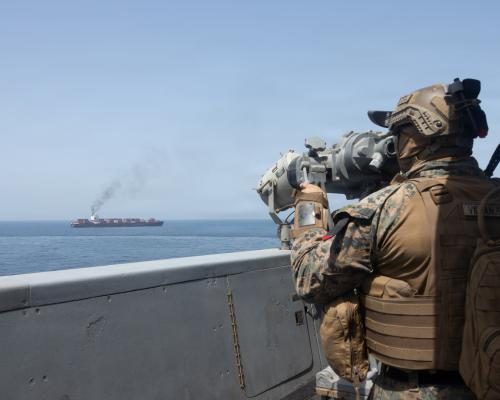
In a significant move, President Donald Trump has announced the indefinite extension of the naval blockade against Iran, a decision that comes amidst rising tensions and military posturing in the region. This strategy may not alleviate global oil prices, but it highlights the increasing risks associated with U.S. military escalation against a regime that remains resolute in its defiance. As military assets are mobilized, the potential for conflict appears to grow.
Military Maneuvers in the Middle East
The U.S. is reinforcing its military presence in the Middle East. The USS George HW Bush, a third carrier strike group, is expected to arrive in the region shortly after navigating around South Africa. Additionally, a second task force comprising 2,500 U.S. Marines is on its way from the Pacific, anticipated to reach its destination by the end of April. These deployments come at a time when the USS Gerald R Ford is already stationed in the Red Sea, having been at sea for over 300 days, raising questions about its operational sustainability. Originally reported by The Guardian.
With the influx of troops and naval assets, the U.S. may be contemplating more aggressive actions, including the potential seizure of Iran's Kharg Island oil terminal, which is critical for the nation's oil exports. This terminal handles around 90% of Iran's oil shipments. The possibility of using 2,000 paratroopers from the 82nd Airborne Division or other Marine units not currently enforcing the blockade has been Discussed, although analysts caution that while capturing Kharg might be feasible, sustaining control over it could prove challenging.
Assessing Military Capabilities and Risks
Matthew Savill from the Royal United Services Institute commented on the situation, stating, "I suspect they would rather threaten an airborne assault or amphibious assault than actually conduct one. The U.S. has the capabilities and firepower to do it. But would it be worth it?" This sentiment reflects a broader concern about the efficacy and consequences of further military actions.
After 38 days of intense bombing campaigns by both the U.S. and Israel, which included 13,000 airstrikes on Iran, the Iranian regime has shown resilience. Despite the loss of an F-15 fighter and two transport aircraft, leaked U.S. intelligence suggests that Iran's military capabilities remain largely intact, with half of its missile systems and drones still operational. Recent aggressive moves by Iran, including the seizure of two commercial vessels in the Strait of Hormuz, demonstrate its continued capacity for retaliation.
The Political Landscape in Iran
The ongoing conflicts have resulted in significant casualties on both sides, with over 3,000 Iranians reportedly killed, including the supreme leader Ali Khamenei. However, the Iranian government still perceives itself as undefeated, with the Islamic Revolutionary Guard Corps now in a position of greater influence. This political context complicates the prospect of any U.S.-Iranian negotiations.
Trump's recent threats to target Iranian infrastructure, such as power plants and bridges, have drawn condemnation and are perceived by some legal experts as potential war crimes. While such actions could cause catastrophic damage to Iran's infrastructure, their effectiveness in compelling Tehran to concede to U.S. demands is highly questionable. Brian Carter, a senior fellow at the American Enterprise Institute, remarked, "This Iranian regime is so incredibly ideological. The actors that are in power are very committed to 'winning the war' and appear willing to suffer extreme economic damage to do so."
Challenges Ahead for U.S. Strategy
Despite the significant military assets at its disposal, including over 50,000 troops in the region, the U.S. faces an uphill battle against Iran's substantial military strength, which includes a 350,000-strong army and a Revolutionary Guard force of 150,000. Recent analyses from the U.S. Center for Strategic and International Studies have raised alarms about the sustainability of U.S. munitions following extensive operations, revealing that over 850 Tomahawk cruise missiles and more than 1,000 JASSM air-to-ground missiles have been used.
This evolving military landscape poses critical questions for U.S. policymakers. The ongoing naval blockade of Iran signifies a commitment to pressure Tehran further, but as the risks mount, it remains to be seen whether this strategy will lead to a resolution or simply escalate tensions further.
Originally reported by The Guardian. View original.