
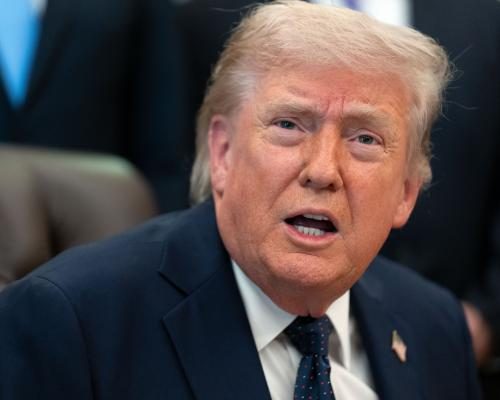
In an escalating response to threats in the Middle East, President Donald Trump has ordered U.S. military forces to "shoot and kill" Iranian boats deploying mines in the strategically vital Strait of Hormuz. This announcement comes as the U.S. extends a ceasefire between Israel and Lebanon by three weeks, aiming to foster dialogue amid rising tensions.
Pentagon's Frustration with NATO Allies
An internal email from the Pentagon has revealed options being considered to penalize NATO allies viewed as insufficiently supportive of U.S. military operations against Iran. A U.S. official, speaking anonymously, indicated that the email expresses significant frustration regarding allies' hesitance in providing access, basing, and overflight rights crucial for the conflict. Among the discussed measures are the suspension of Spain from NATO and a reevaluation of America's stance on Britain's claim to the Falkland Islands. Originally reported by The Guardian.
The email reportedly emphasizes that such access is "just the absolute baseline for NATO." The U.S. has faced criticism from Trump, who has urged allies to contribute naval support to re-open the Strait of Hormuz, which has been closed to global shipping due to escalating hostilities. He has also hinted at the possibility of withdrawing U.S. support from the alliance, stating, "Wouldn't you if you were me?" However, the options do not include closing military bases in Europe.
U.S. Offers Bounty on Militia Leader
In a related move, the U.S. State Department has placed a bounty of up to $10 million on Hashim Finyan Rahim al-Saraji, the leader of the Iran-backed Shia militia, Kata'ib Sayyid al-Shuhada (KSS). The militia has been implicated in numerous attacks against Iraqi civilians and U.S. facilities in Iraq and Syria, denoted as a terrorist organization by the State Department's "Rewards for Justice" program.
As part of a broader Strategy, Israel and the U.S. have intensified efforts to dismantle Iran's network of militant groups across the region. Iraq has emerged as a crucial battleground in this covert war, with militias composed primarily of the Shia majority receiving directives from the Islamic Revolutionary Guard Corps of Iran. The unfolding scenario has led to heightened tensions and increased military presence in the area.
Market Reactions to Ongoing Crisis
Global financial markets have reacted negatively to the ongoing crisis, with Asian stocks generally lower and oil prices continuing to rise amid stalled negotiations to end the conflict. U.S. futures dipped as Wall Street retreated from its recent all-time highs. The Nikkei 225 in Tokyo saw a modest increase of 0.6%, bolstered by strong technology sector performance, while other major indices faced declines, including a 0.8% drop in Hong Kong's Hang Seng and a 0.5% fall in Shanghai's Composite Index.
In commodities, Brent crude prices saw a notable rise of 3.1% on Thursday, closing at $105.07 per barrel, with prices briefly surpassing $107. Early Friday trading showed a slight increase, with Brent crude at $99.70 per barrel and U.S. benchmark crude at $96.62 per barrel. These price increases are largely attributed to fears surrounding supply disruptions amidst the ongoing military conflicts.
Ceasefire Extended Between Israel and Lebanon
In the diplomatic sphere, President Trump announced the extension of a ceasefire between Israel and Lebanon for an additional three weeks. During a meeting in the Oval Office, Trump expressed hope that this timeframe would facilitate discussions between the leaders of the two nations. Lebanese Ambassador to the U.S., Nada Moawad, expressed gratitude for Trump's involvement, stating, "I think with your help, with your support, we can make Lebanon great again." This extension signals a cautious optimism in the region as both sides seek to address long-standing issues contributing to the conflict.
The situation in the Middle East remains fluid, with military actions and diplomatic efforts intertwined. As the U.S. continues to assert its military presence and support for allies, the potential for a broader conflict looms, leaving many to question how these developments will shape the geopolitical landscape in the months to come.
Originally reported by The Guardian. View original.