
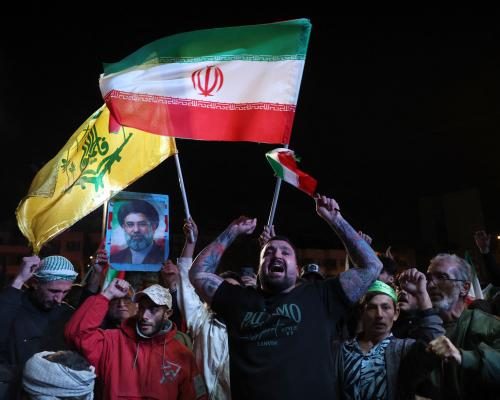
The recent announcement of a Two-week Ceasefire has revived hopes of peace in the Middle East, with Donald Trump declaring the reopening of the Strait Of Hormuz as a pivotal victory. However, analysts suggest that Iran enters forthcoming negotiations with a significantly stronger position, bolstered by its military resilience and nuclear capabilities.
Trump's Short-Term Gains Amid Long-Term Challenges
Following the ceasefire declaration, President Donald Trump hailed the situation as a momentous turning point, proclaiming it the beginning of a new golden age. His remarks appeared to resonate in the global markets, with oil prices dropping and stock indices showing signs of recovery. However, this perceived victory may be superficial, as the complexities of the ceasefire terms remain ambiguous. Trump emphasized that the ceasefire hinged on the "complete, immediate and safe opening of the Strait of Hormuz," a critical maritime route for global oil shipments. Originally reported by The Guardian.
In contrast, Iranian officials have indicated that while shipping through the strait will resume, it will be under the control of the Iranian armed forces. This move signifies a shift in power dynamics, as Tehran not only asserts its authority over the strait but also proposes to share control with Oman, potentially instituting tolls of $2 million per vessel. Such a change would mark a significant departure from the past, when the strait was considered a free waterway.
Iran's Strategic Position in Negotiations
The Iranian delegation's arrival in Pakistan for peace talks comes at a time when the regime is demonstrating resilience despite suffering significant losses during the conflict. Tehran holds a considerable stockpile of highly enriched uranium, estimated at 440 kg, which could theoretically be converted into multiple nuclear warheads. This stockpile has now become a pivotal bargaining chip in the negotiations.
While the U.S. has traditionally maintained a hardline stance against Iran's nuclear ambitions, the circumstances have shifted. Reports suggest that Iran's ten-point plan, which includes demands for lifting sanctions and reparations, will serve as the basis for discussions. Notably, Iran's insistence on its right to enrich uranium, included in the Farsi version of the ceasefire terms but omitted in the English translation, underscores its determination to retain this critical advantage.
Contradictory Statements and Uncertain Ceasefire Terms
As the ceasefire unfolds, conflicting interpretations of its scope have emerged. Pakistani Prime Minister Shehbaz Sharif claimed that the ceasefire extends "everywhere including Lebanon," a statement quickly dismissed by Israeli Prime Minister Benjamin Netanyahu, who vowed to continue military operations in the region. This discord raises questions about the ceasefire's effectiveness and the stability of the current truce.
Trump's administration, faced with growing frustration over Iran's conditions, may find itself in a precarious position during the talks. Despite issuing dire warnings, including a statement that "a whole civilization will die," there appears to be little movement from Iran on key issues. The Iranian government's position, fortified by its demonstrated capacity to withstand pressure, sends a clear message that it will not easily concede its demands.
Implications for Future Relations
The new negotiating landscape presents significant challenges for the U.S. as it navigates its relationship with Iran. The Iranian regime enters these talks with a sense of victory, having shown its ability to endure the worst of U.S. and Israeli aggression. Despite severe setbacks, including the death of its supreme leader, Iranian forces continue to demonstrate military capacity by launching missile strikes against U.S. allies.
As negotiations commence, the geopolitical implications of Iran's control over the Strait of Hormuz cannot be overstated. With hundreds of vessels currently trapped in the Gulf, shippers are likely to become increasingly cautious, fearing that payment of tolls to Iran could violate U.S. sanctions. This uncertainty could stifle maritime activity and reshape the global oil market.
Ultimately, as the U.S. delegation prepares for discussions in Islamabad, it must contend with a new reality-one where Iran's strategic advantages may redefine the parameters of future agreements. The outcome of these talks could significantly influence not only U.S.-Iran relations but also the broader stability of the Middle East.
Originally reported by The Guardian. View original.