
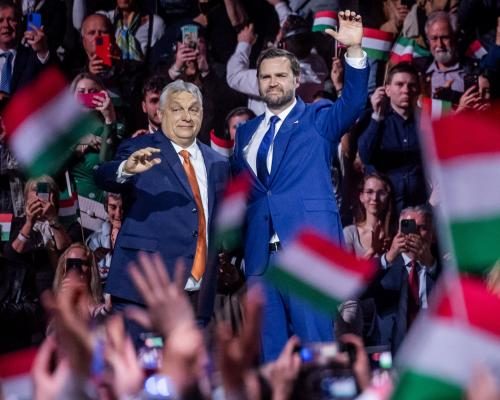
U.S. Vice President JD Vance is currently in Budapest, Hungary, where he is set to address the Mathias Corvinus Collegium following a contentious endorsement of Prime Minister Viktor Orbán. Vance's comments, which accused the European Union of interfering in Hungary's upcoming elections, have stirred significant debate just days before the key vote. His remarks raise questions about U.S. involvement in foreign elections and the broader implications for European politics.
Vance's Position on EU Interference
During his visit, JD Vance has been vocal about his belief that the European Union is meddling in Hungary's electoral process. He has argued that such interference undermines Hungary's sovereignty and the democratic choices of its people. Vance's claim comes at a pivotal time, as Hungary prepares for elections on Sunday. His remarks have sparked criticism, suggesting that his support for Orbán could be perceived as U.S. interference in another nation's electoral affairs. Originally reported by The Guardian.
Vance's comments have drawn attention to the ongoing tensions between Hungary and the EU, particularly regarding issues of rule of law and democratic governance. Critics argue that his statements could be seen as hypocritical, given that they come from the Vice President of a country that has its own complicated history with foreign interventions. The juxtaposition of Vance's endorsement of Orbán and his accusations against the EU is striking and raises important questions about the nature of international support and influence.
Zelenskyy Advocates for Ceasefire in Ukraine
As Vance navigates his visit to Hungary, Ukrainian President Volodymyr Zelenskyy is also making headlines with his comments on the ongoing conflict in Ukraine. Responding to news of a ceasefire in Iran, Zelenskyy expressed his commitment to achieving a similar resolution in Ukraine. He stated, "A ceasefire is the right decision that leads to ending the war. It means saving lives, abandoning the destruction of cities and villages, and allowing power plants and other infrastructure to operate normally."
Zelenskyy emphasized that a ceasefire would create the necessary conditions for productive diplomatic negotiations. He reiterated Ukraine's longstanding call for a cessation of hostilities and expressed his willingness to reciprocate if Russia halts its strikes against Ukraine. The president pointed out the interconnectedness of global security, mentioning that instability in the Middle East could exacerbate challenges in Europe.
European Leaders React to Middle East Ceasefire
Simultaneously, European leaders have reacted positively to a Provisional Ceasefire deal between the United States and Iran. European Commission President Ursula von der Leyen welcomed the agreement, noting that it could lead to much-needed de-escalation in the region. French President Emmanuel Macron described the deal as "a very good thing" and underscored the importance of respecting the ceasefire to foster further negotiations.
However, Spain's Prime Minister Pedro Sánchez took a more critical stance, indicating that while ceasefires are positive, they should not distract from the chaos and destruction caused by the conflict. He remarked, "The Spanish government will not applaud those who set the world on fire just because they show up with a bucket," stressing the need for diplomacy and lasting peace.
Implications for NATO and U.S. Foreign Policy
As Vance continues his visit, the implications of his remarks extend beyond Hungary. With NATO's Mark Rutte scheduled to meet with U.S. officials, including former President Trump, there is speculation about how U.S. foreign policy might shift. Rutte's discussions are particularly significant in light of recent frustrations within NATO regarding the alliance's direction and the U.S.'s role in European security.
The outcome of these discussions could have far-reaching consequences for both transatlantic relations and the geopolitical landscape. As Vance's visit unfolds, observers will be keenly watching how the U.S. navigates its relationships with European allies amid contrasting approaches to foreign policy.
JD Vance's actions in Hungary and the broader discussions surrounding ceasefires and diplomatic efforts reflect a complex web of international relations at a critical juncture. As the situation develops, the intersection of U.S. domestic politics and international diplomacy will continue to draw scrutiny.
Originally reported by The Guardian. View original.