
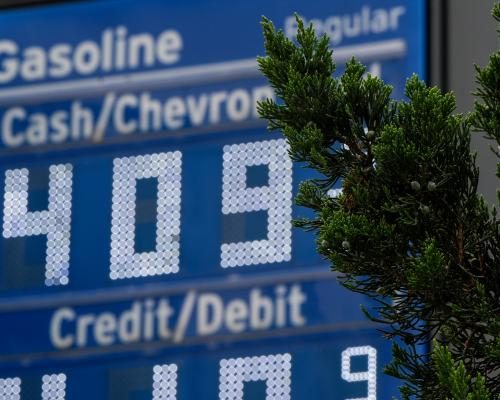
As the conflict between the U.S. and Iran intensifies, defense contractors and oil companies are experiencing significant financial gains. With gas prices soaring and inflation concerns mounting, the economic landscape is shifting dramatically five weeks into the ongoing war.
Gas Prices Surge Amid Ongoing Conflict
The ongoing military conflict involving the U.S. and Israel against Iran has sent gas prices soaring, with average costs climbing toward $4 a gallon. This surge is attributed to the geopolitical instability in the Middle East, particularly Iran's ongoing blockade of the Strait of Hormuz, a crucial passage for global oil transportation. As the conflict escalates, fears of supply disruptions have fueled price increases, with U.S. crude oil prices nearly doubling from $65 a barrel to over $110 a barrel in just one month. Originally reported by The Guardian.
Critics have pointed fingers at the Biden administration, suggesting that the military engagement could further frustrate American voters grappling with rising gas prices. Donald Trump, utilizing social media platform Truth Social, sought to reassure Americans, claiming, "The United States is the largest Oil Producer in the World, by far, so when oil prices go up, we make a lot of money." This statement reflects a growing concern about how the conflict might impact everyday citizens.
Defense Contractors Experience Stock Price Surge
The financial landscape for defense contractors has also taken a favorable turn. Recently, the U.S. Department of Defense announced that Boeing would partner with Lockheed Martin to significantly increase the production of missile seekers. This news resulted in a notable rise in Lockheed Martin's stock price, which has surged by 25% since the beginning of the year. As military spending increases in response to heightened tensions, defense contractors are poised to benefit substantially.
These developments come at a time when the stock market is generally experiencing a downturn. However, defense and energy companies, including Lockheed Martin, are bucking this trend, showcasing their resilience amid uncertainty. With heightened military operations, these firms are likely to see continued growth in their share prices, making them attractive investments during turbulent times.
Oil Companies Reap Windfall from Price Increases
While consumers face rising gas prices, U.S. oil companies are enjoying a financial bonanza. The increase in global oil prices has led to a significant boost in share values for major firms such as ExxonMobil, Shell, and Chevron, all of which have seen their stock prices rise by over 20% since the start of the year. Analysts estimate that U.S. oil producers could see an additional $63 billion in profits as oil prices surpass $100 a barrel.
Leo Mariani, a senior research analyst at Roth Capital Partners, noted, "[Oil prices] in the month of March have been materially higher than any of these guys had expected. So certainly at this point in time, it's been a windfall for the vast majority of U.S. energy companies." The situation mirrors past events, such as the price shocks experienced in 2022 following Russia's invasion of Ukraine, when oil companies recorded record profits.
Disparity in Profit Distribution Raises Concerns
As oil companies enjoy booming profits, economic disparities are becoming increasingly apparent. Research from economists, including Gregor Semieniuk of the University of Massachusetts at Amherst, indicates that 50% of the profits generated by U.S. oil companies in 2022 were concentrated among the top 1% of Americans. In contrast, only a mere 1% of those profits trickled down to the bottom half of the wealth distribution.
This trend raises critical questions about income inequality and the broader implications for American consumers. The current oil price shocks may yield even greater profits for oil companies due to the damage inflicted on oil infrastructure in the Middle East as a result of the conflict. Unlike the past, where oil was merely shuffled on the market, the current situation represents a more severe supply disruption.
While higher oil prices can benefit companies, prolonged high prices may lead consumers to seek alternatives, as seen in previous decades. With the market dynamics shifting, it's uncertain how long these companies can sustain their profits, especially if consumer behavior changes in response to sustained high prices.
The geopolitical landscape continues to evolve, and the economic consequences of the U.S.-Iran conflict are likely to resonate in the coming months. While defense contractors and oil companies thrive, the broader implications for American consumers remain uncertain. As gas prices reach levels not seen since 2022, it becomes increasingly important to monitor the ongoing developments and their potential impact on the economy.
Originally reported by The Guardian. View original.