
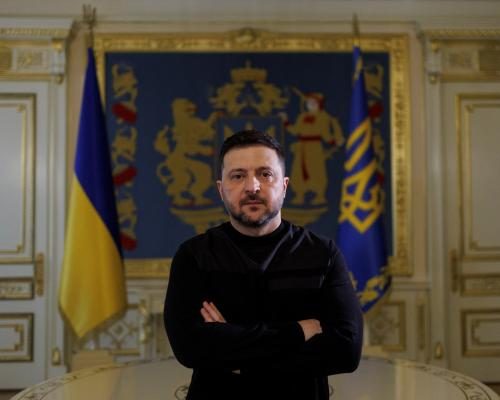
Ukrainian President Volodymyr Zelenskyy revealed in a recent interview with Reuters that the United States has conditioned its security guarantees for a potential peace agreement on Ukraine ceding the eastern Donbas region to Russia. This development comes as the U.S. faces its own geopolitical challenges, particularly its conflict with Iran, which has shifted focus away from the ongoing war in Ukraine.
U.S. Pressure Amid International Tensions
During his interview, Zelenskyy articulated concerns regarding President Donald Trump's approach towards Ukraine, suggesting that the U.S. leader is exerting undue pressure to expedite a resolution to the four-year conflict initiated by Russia's invasion in 2022. "The Middle East definitely has an impact on President Trump, and I think on his next steps. President Trump, unfortunately, in my opinion, still chooses a strategy of putting more pressure on the Ukrainian side," Zelenskyy stated. The implications of this pressure are significant for Ukraine, as ceding any part of Donbas could jeopardize the country's territorial integrity and security. Originally reported by The Guardian.
Zelenskyy emphasized that the eastern region is integral to Ukraine's security guarantees, stating, "I would very much like the American side to understand that the eastern part of our country is part of our security guarantees." This statement underscores the complexities that arise when international diplomacy intersects with national sovereignty and security.
Claims of Intelligence Blackmail
The Ukrainian president also accused Russia of attempting to manipulate U.S. intelligence operations. Zelenskyy claimed that Russia offered to cease sharing military intelligence with Iran if the United States reciprocated by cutting off intelligence support to Ukraine. "I have reports from our intelligence services showing that Russia is doing this and saying: 'I will not pass on intelligence to Iran if America stops passing intelligence to Ukraine.' Isn't that blackmail? Absolutely," he asserted. This allegation not only highlights the intricate web of international relations but also the high stakes involved in the ongoing conflict.
Moreover, Zelenskyy noted that Ukraine possesses "irrefutable" intelligence confirming that Russia continues to share information with Iran, raising concerns about the broader implications of such collaborations. The ongoing exchange of intelligence between Russia and Iran could further complicate U.S. efforts to contain both nations.
Continued Hostilities and Civilian Casualties
In the backdrop of these diplomatic tensions, the conflict in Ukraine continues to escalate. Recent reports indicate that Russian attacks have resulted in casualties, including the deaths of two individuals in Kharkiv and surrounding areas. Prosecutors in the Kharkiv region confirmed that a woman succumbed to injuries sustained in an attack, while nine others were reported injured in strikes that targeted two districts of the city, located approximately 30 kilometers from the border.
Additionally, a drone strike in a district closer to the border claimed the life of a man in his vehicle. On the flip side, Ukrainian drone strikes resulted in fatalities in Russia's Belgorod region, with reports of two individuals killed, one of whom was an 18-year-old riding a motorcycle. These developments illustrate the ongoing cycle of violence that shows no signs of abating.
International Reactions and Escalating Sanctions
Internationally, the fallout from the conflict is being felt far and wide. Zimbabwe announced that 15 of its citizens have died while fighting for Russia, with officials labeling the situation as a case of human trafficking. The Zimbabwean Information Minister Zhemu Soda indicated that traffickers have been using social media to recruit individuals into combat roles, further complicating the narrative around foreign involvement in the conflict.
On the European front, British Prime Minister Keir Starmer has authorized military action to detain Russian ships allegedly involved in circumventing sanctions. Starmer described the move as necessary, given the financial windfall Moscow has experienced from the rise in oil prices amid the ongoing U.S.-Israel conflict with Iran. This step reflects a broader strategy among European nations to disrupt the financial networks supporting Russia's military operations.
As the war in Ukraine continues to evolve, the stakes remain high for all parties involved. The interplay between military action, international diplomacy, and domestic pressures will undoubtedly shape the future of the region. With Zelenskyy's claims about U.S. conditions on peace negotiations, the path to resolution appears fraught with challenges that will require careful navigation.
Originally reported by The Guardian. View original.