
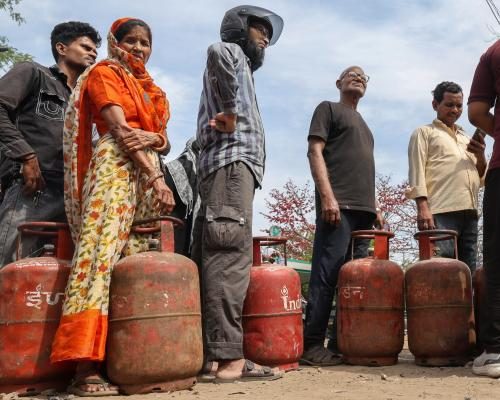
Delhi resident Maya Rani, 36, has spent four consecutive days waiting at a gas distributor's office, clutching her six-month-old daughter, hoping to secure a cooking gas cylinder. Each day, she leaves empty-handed, informed that supplies are critically low and may not arrive for another week. This scenario is playing out across South Asia as the region grapples with its most severe gas crisis in decades, triggered by disruptions in liquefied petroleum gas (LPG) supplies due to the ongoing conflict in Iran.
As Rani waits, the queue lengthens, filled with anxious individuals clutching forms and documents. Last week, the family's small gas cylinder ran out, and her husband, unable to take time off work, sent her to the distributor. "I feel like crying," she expressed, trying to soothe her child on the pavement outside the office. "We have been waiting for days and still don't know when we will get gas." The family's meals have dwindled to just one per day, largely from outside sources, and they've even sought help from neighbors to boil milk for the baby. Originally reported by The Guardian.
Supply Disruptions Spark Regional Panic
The crisis stems from the closure of the Strait of Hormuz, a vital maritime chokepoint that carries about 20% of global fuel shipments, predominantly to Asia. With the Iran conflict effectively halting operations in this region, the ripple effects are being felt acutely in India, Pakistan, Bangladesh, Nepal, and Sri Lanka, where LPG is essential for daily cooking. As imports slow, distribution networks are under immense strain, forcing governments to prioritize household supplies and restrict commercial access.
Akhtar Malik, of the Bureau of Research on Industry and Economic Fundamentals (Brief) in Delhi, noted, "This level of exposure was absolutely anticipated. The strait of Hormuz as a chokepoint and the risks it poses have been extensively studied and debated for years." However, South Asian nations have failed to create adequate buffers or diversify their energy sources, leaving them vulnerable to geoPolitical upheavals. India, for instance, has only about 20 days of LPG storage capacity, a stark contrast to the global standard of 40 to 60 days of reserve cover.
Economic Ramifications of the Gas Shortage
India imports approximately 60% of its LPG, with around 90% of those imports passing through the Strait of Hormuz. Since the strait's closure, only two cargoes have successfully navigated through, far from sufficient to meet daily demand. The Indian government has been compelled to maximize domestic LPG production, directing refineries to prioritize household use. Hospitals and educational institutions are receiving preferential treatment in supply allocations, leaving businesses scrambling amid dwindling resources.
Restaurants and hotels have been particularly hard-hit. Industry estimates suggest that around 20% of eateries in Mumbai have either shut down or reduced operations significantly. Nandu Kishore, manager of Shawaya House in south Delhi, shared the struggle: "We have 30 items on the menu, but we're selling no more than six. Even those are only possible because we've started using coal." With Eid al-Fitr approaching, the timing couldn't be worse for businesses that typically thrive during this period.
Workers and Households Bear the Brunt
The situation is dire for workers in gas-dependent industries. In Morbi, Gujarat, known as the world's second-largest tile manufacturing hub, nearly 450 out of 670 ceramic units have ceased operations, crippling local employment. Shahidul Alam, a worker from West Bengal, shared his distress at a railway station, stating, "The manager told us the factory is shutting and we won't be paid. Without work, we can't survive - how will we eat?" His experience echoes the plight of many who have faced similar hardships during the COVID-19 lockdown.
Tensions are rising as the crisis unfolds. Gas distribution centers are becoming sites of heated arguments, and even LPG trucks have reportedly become targets for theft due to the tightening supply. With many households unable to access cooking gas, the desperation is palpable across communities.
As South Asia navigates its way through this unprecedented gas crisis, the immediate future remains uncertain. While governments scramble to manage existing supplies and address the mounting frustrations of their citizens, the need for strategic planning and diversification of energy sources has never been more apparent. The events of recent weeks serve as a stark reminder of the vulnerabilities inherent in dependence on geopolitical supply chains.
Originally reported by The Guardian. View original.