
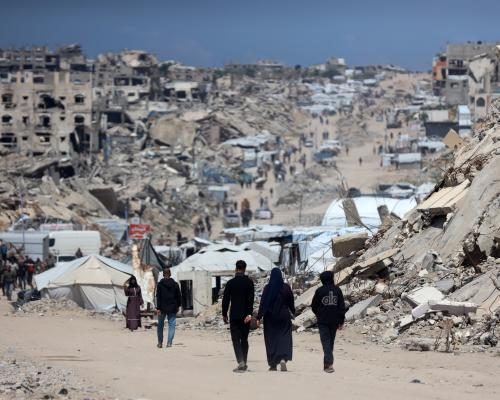
The UK Foreign Office has closed a unit dedicated to monitoring potential breaches of international law by Israel in Gaza and Lebanon, a decision stemming from departmental budget cuts. This closure follows a review by Olly Robbins, the former permanent secretary, who was dismissed last week amid a political scandal. The move raises concerns about the UK government's commitment to international law, especially following recent statements from Foreign Secretary Yvette Cooper.
Significant Cuts to Humanitarian Law Oversight
According to recent revelations, the Foreign Office's international humanitarian law (IHL) cell, which had been crucial in tracking Israel's military Actions, has been shut down due to financial constraints. This closure comes just two weeks after Foreign Secretary Yvette Cooper emphasized the importance of international law in her major foreign policy address, stating that it would be a cornerstone of her department's approach. Originally reported by The Guardian.
The IHL cell's closure signifies not only a reduction in oversight but also the end of funding for the Conflict and Security Monitoring Project operated by the Centre for Information Resilience (CIR). This project was known for conducting extensive open-source monitoring of incidents in Israel, Palestine, and Lebanon, with an impressive database housing 26,000 verified incidents dating back to October 7, 2023, the date of the Hamas attack on Israel.
Impact on Conflict Monitoring and Human Rights
The termination of the Conflict and Security Monitoring Project will leave the Foreign Office without a vital resource that has supported its analysis of arms export controls and compliance with international humanitarian law. The database maintained by the CIR has provided essential insights into potential atrocities and human rights violations, assisting in decisions regarding arms export licenses to Israel.
Furthermore, the project has been instrumental in warning the Foreign Office of potential human rights abuses in conflict zones, including Sudan. The closure of the IHL cell and the monitoring project represents a significant step back in the UK's ability to respond effectively to international humanitarian crises and uphold its commitments to human rights.
Political Context and Future Implications
The decision to close the IHL cell is part of broader cuts driven by a reduction in the overseas aid budget to 0.3% of gross national income, despite maintaining a target of 0.7% when resources allow. Olly Robbins, prior to his dismissal, had been overseeing a restructuring that included the elimination of several teams within the Foreign Office, including this key humanitarian oversight unit.
Cooper's Mansion House speech underscored her belief in the importance of international law, stating, "It might be tempting to think that international law and the role of international frameworks are out of date.. the role that rules-based frameworks play is vital." This contradiction between her proclamations and the actual operational decisions raises questions about the government's commitment to upholding international norms.
Expert Concerns Over Reduced Oversight
Experts and officials have expressed alarm over the implications of shutting down the IHL cell and the Conflict and Security Monitoring Project. The head of the war crimes team within the counter-terrorism unit had previously urged the Foreign, Commonwealth & Development Office (FCDO) to recognize the significance of the CIR's work, particularly in supporting investigations into potential war crimes.
The CIR has also conducted over 20 open-source investigations, including inquiries into unlawful shootings of minors in Gaza. The intelligence and assessments provided by the CIR have been relied upon by UK embassies in Tel Aviv, Beirut, and Damascus, which sought rapid responses to significant incidents in the region.
With the Israel-Gaza conflict escalating, the closure of the IHL cell could hinder the UK's ability to monitor developments effectively and respond to potential breaches of international law. This could have long-lasting implications for the UK's foreign policy and its role on the global stage.
As the situation in the Middle East continues to evolve, the lack of robust monitoring mechanisms raises critical questions about the future of the UK's commitment to international law and human rights advocacy. The recent cuts may lead to diminished oversight and accountability at a time when such measures are more necessary than ever.
Originally reported by The Guardian. View original.