
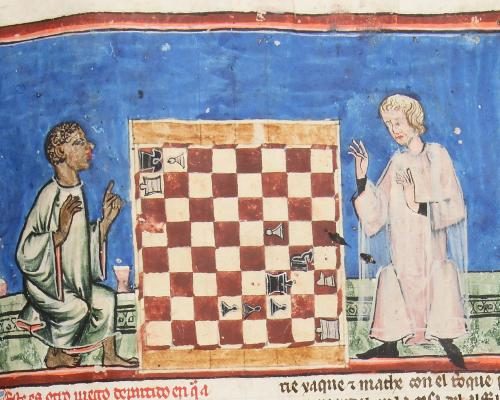
Black and white pieces face off on the chessboard, but new research suggests that medieval chess was not merely a game of conflict. Instead, it served as a platform for equality and intellectual exchange among players of diverse backgrounds. Dr. Krisztina Ilko, a historian at the University of Cambridge, has meticulously analyzed medieval manuscripts, paintings, and chess sets, revealing an unexpected narrative of mutual respect and equality in the game.
Rediscovering the Game's Historical Context
Dr. Ilko's research Highlights the 13th-century treatise, Libro de axedrez, which was commissioned by King Alfonso X of Castile. This richly illustrated text features numerous depictions of players from Africa, the Middle East, and Asia, challenging conventional views of medieval social attitudes. In one illustration, a Black player is shown poised to defeat a white opponent while relaxing on an ornately decorated bench, a bottle of wine nearby. In another scene, four Mongol men, typically caricatured as fierce warriors, engage in a friendly game, with one leaning casually on his saber-his weapon serving more as decoration than a threat. Originally reported by The Guardian.
These images serve as a reminder that, despite the political conflicts and religious divisions of the era, chess provided a unique avenue for bridging social divides. Ilko notes that while medieval society was often characterized by rigid hierarchies and prejudices, the chessboard offered a space where intellect triumphed over skin color and social status.
The Game as a Space for Equality
According to Dr. Ilko, chess operated on a different level from everyday life, allowing players to engage one another as equals. She states, "What mattered was 'who's smarter?', 'who can win?', not 'who's more powerful or socially superior?'" This perspective is critical in understanding how chess could both reflect and challenge the social norms of the time.
In her paper titled Chess and Race in the Global Middle Ages, published in the journal Speculum, Ilko has been recognized with the Medieval Academy of America's Article Prize in Critical Race Studies. Her findings suggest that chess was seen as "war without bloodshed," embodying a vision of a more just world. The game became a metaphor for how society could function through orderly moves and intellectual exchange, transcending race and societal hierarchies.
Chess as a Cultural Exchange
Dr. Ilko emphasizes the cultural significance of chess during King Alfonso's reign, when his court actively sought out and translated Islamic knowledge. Of the 103 chess problems presented in the Libro de axedrez, a remarkable 88 follow the Muslim playing style. This highlights the game's role as a vessel for cultural exchange, allowing diverse players to engage with one another intellectually.
Furthermore, Ilko points to various medieval artworks, from a late 14th-century altarpiece in the church of San Nicolás in Mallorca to illustrated versions of the Persian epic Shahnama, which also depict players of darker skin engaging in chess. These works challenge the prevailing value systems that prioritized whiteness and reflect a more nuanced understanding of medieval identities.
The Evolution of Chess and Its Global Impact
The origins of chess trace back to Chaturanga, a board game from 7th-century India, where pieces represented distinct army units. As the game spread across civilizations, it evolved, taking on human characteristics and cultural significance. Dr. Ilko notes that the dual color of chess pieces has allowed for projections of race and skin color onto the game over centuries. However, this duality also enabled a competitive framework that emphasized skill over status.
"Chess was a game of war, which prompted not only an occasion for social interaction but also an active and competitive challenge between two players who each had an equal opportunity to win, regardless of status, wealth, or skin color," Ilko explains. Today, while the medieval world has significantly changed, chess remains a global phenomenon, reflecting a rich tapestry of cultures and histories.
As Dr. Ilko's research uncovers the complex narratives woven into the game of chess, it becomes clear that this ancient pastime offers more than just entertainment. It serves as a mirror to societal values, challenging us to reconsider the intersection of race, culture, and intellect in our shared history.
Originally reported by The Guardian. View original.