
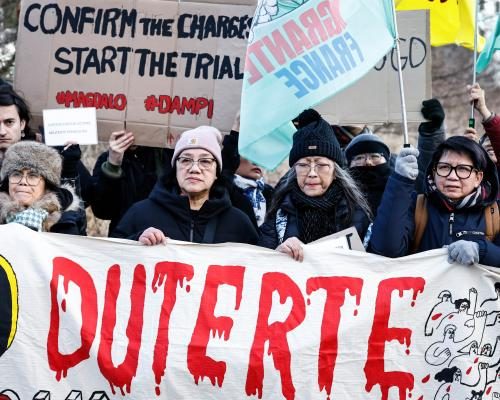
Rodrigo Duterte, the former president of the Philippines, is poised to face trial at the International Criminal Court (ICC) as judges have confirmed charges of crimes against humanity related to his controversial "war on drugs." The pre-trial judges reached this unanimous decision on Thursday, establishing substantial grounds to believe that Duterte was responsible for murder and attempted murder during anti-drug crackdowns that resulted in the deaths of thousands.
Charges Rooted in Systematic Violence
The charges against Duterte stem from allegations that his administration's anti-drug operations constituted a "widespread and systematic attack" on the civilian population. These operations began in 2016 when Duterte took office and can be traced back to his earlier tenure as mayor of Davao City. Reports suggest that as many as 30,000 civilians may have been killed in connection with drug-related operations, with Duterte's policies disproportionately affecting men from impoverished urban areas who were shot in the streets or within their homes. Originally reported by The Guardian.
While the Philippine National Police has reported over 6,000 deaths linked to these operations, human rights organizations argue that the actual numbers are significantly higher. Duterte, now 80 years old, has consistently denied the allegations against him, asserting that his government acted within the law during its efforts to combat illegal drugs. However, the ICC's ruling indicates that there is sufficient evidence to proceed with the case.
Reactions from Victims' Families and Activists
Families of victims have expressed relief and hope following the court's decision. Nanay Llore, a mother who lost two sons to the drug war, stated, "We have long waited for this moment. It's been nearly 10 years since Duterte started implementing his deadly 'war on drugs.' We look forward to seeing him in ICC court." The advocacy group Rise Up for Life and for Rights, which represents families affected by the drug killings, echoed similar sentiments, emphasizing that justice has been a long time coming.
Ritz Lee Santos, the director of Amnesty International in the Philippines, celebrated the ruling, calling it a "historic moment for victims and international justice." The decision marks a significant milestone in the global response to human rights violations, particularly in the context of Duterte's controversial policies.
Arguments and Defenses in Court
While the prosecution has portrayed Duterte as being "at the very heart" of the anti-drug campaign, his defense team argues that the former president is unfit to stand trial, citing cognitive decline and health issues. In a statement, Duterte described himself as "old, tired and frail," noting that he experiences memory loss. His lawyers have claimed that the ICC lacks jurisdiction over the case, an argument that has been dismissed by the court.
During the February pre-trial hearings, prosecutors contended that Duterte authorized extrajudicial killings, asserting that he wielded "ultimate influence and authority" over the perpetrators of the violent anti-drug campaigns. They highlighted his past declarations, including a provocative statement made in a television interview where he warned, "If I become president, you will all get wiped out. I will order your execution within 24 hours." Such admissions have been central to building the case against him.
The Road Ahead for Duterte and ICC Proceedings
As the date for the trial remains undecided, uncertainty looms over whether Duterte will attend. In earlier hearings, he did not appear, leading to speculation about his willingness to confront the charges. His lawyer, Nicholas Kaufman, has dismissed the allegations of a state-sanctioned killing policy as a "complete fiction," asserting that the evidence against Duterte will be proven baseless during the trial.
The ICC's decision to proceed with the case against Duterte not only underscores the international community's commitment to addressing human rights abuses but also sets a precedent for future accountability. The implications of this trial could resonate beyond the Philippines, potentially influencing other nations grappling with similar issues of state violence and impunity.
As the world watches closely, the unfolding proceedings at the ICC may serve as a critical litmus test for international justice mechanisms and their ability to hold powerful leaders accountable.
Originally reported by The Guardian. View original.