
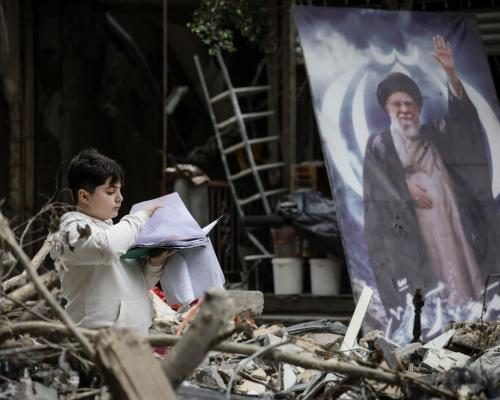
Former President Donald Trump announced on Tuesday that the United States would extend a ceasefire in the ongoing conflict involving Iran, responding to a request from Pakistan. This decision comes as Trump discussed the economic situation in the United Arab Emirates (UAE) during a CNBC interview, igniting a swift rebuttal from the UAE's ambassador to the US.
Trump's remarks centered on the UAE's wartime economy, where he implied that the nation might be facing financial difficulties due to the ongoing conflict with Iran. He mentioned that the US was exploring financial assistance options for the UAE, including a potential currency swap. "It is," Trump confirmed when asked about the currency swap during the interview, emphasizing the UAE's status as a key ally. "They're really led by incredible people.. I mean, I'm surprised, because they are really rich," he added. "If I could help them, I would, I mean, we're helping them much more with what we're doing with the war." Originally reported by The Guardian.
UAE Ambassador Defends Economic Resilience
In response, Yousef Al Otaiba, the UAE's ambassador to the US, quickly dismissed any notion that the UAE was in dire economic straits. He expressed gratitude for Trump's acknowledgment of the UAE as a vital partner but firmly stated, "Any suggestion that the UAE requires external financial backing misreads the facts." Al Otaiba pointed to the UAE's robust financial position, which includes over $2 trillion in sovereign investment assets, more than $300 billion in foreign currency reserves, and a banking sector with approximately $1.5 trillion in deposits.
The UAE is a federation of seven emirates, including the prosperous cities of Abu Dhabi and Dubai. While it has managed to export some oil through a pipeline to the Gulf of Oman, the ongoing turmoil around the Strait of Hormuz has severely hindered its oil exports, impacting its economic stability. The conflict has also taken a toll on Dubai's local businesses and the operations of its major airlines, Emirates and Etihad.
Global Fuel Crisis Hits Pacific Nations Hard
The fallout from the conflict extends beyond the Middle East, as far-flung nations in the Pacific are grappling with a global fuel crisis. Aid organizations report that fuel prices have surged by as much as 70% in countries like Papua New Guinea since the onset of the Iran war. The International Finance Corporation noted that Pacific Island nations are particularly vulnerable, being the most reliant on diesel for power generation globally.
In 2025 alone, these Pacific countries imported around 2.2 million metric tons of various fuels, primarily from Singapore and South Korea. However, data from Kpler shiptracking revealed that imports during the first half of April were only a quarter of the total for March. This has led to dire consequences in nations like Kiribati, where citizens face challenges accessing work, education, and healthcare. In response to the escalating crisis, both Tuvalu and the Marshall Islands have declared states of emergency, while countries like the Cook Islands and Papua New Guinea are taking measures to subsidize or cap rising fuel costs. Notably, Fijian ministers have agreed to a 20% pay cut to help alleviate some of these burdens, pending parliamentary approval.
Trump Claims Iran is Financially Collapsing
On social media, Trump asserted that Iran is "collapsing financially," claiming the nation is losing $500 million daily due to the closure of the Strait of Hormuz. He stated, "They want the Strait of Hormuz opened immediately-Starving for cash! Losing 500 Million Dollars a day," reflecting his belief that Iran is under significant financial pressure. Trump further noted that Iranian military and police forces are reportedly struggling to receive their salaries amid the crisis.
With tensions high, Trump insinuated that Iran is eager to reopen the Strait but warned that any negotiations would require severe consequences for the country. "People approached me four days ago, saying, 'Sir, Iran wants to open up the Strait, immediately.' But if we do that, there can never be a Deal with Iran, unless we blow up the rest of their Country, their leaders included!"
As the geoPolitical landscape remains in flux, global markets are responding to the uncertainty. Early trading in Asia showed mixed results, with oil prices slightly easing amid hopes that US-Iran talks could resume. Brent crude dipped 0.2% but remained above $98 a barrel, while US benchmark crude fell 0.4% to $89.29 a barrel. This volatility reflects broader concerns about inflation, which the International Monetary Fund predicts will accelerate to 4.4% this year, higher than earlier estimates.
Originally reported by The Guardian. View original.