
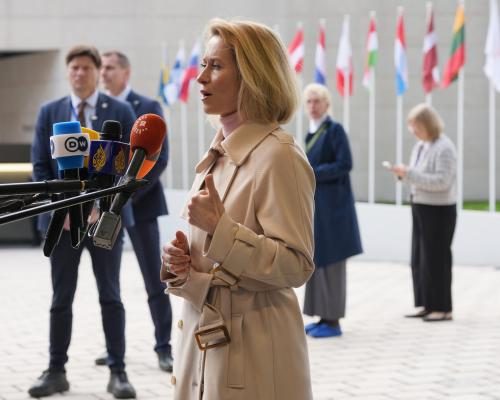
The European Union (EU) foreign ministers convened on Tuesday and ultimately decided against suspending the association agreement with Israel. Despite growing criticism from several member states regarding Israel's actions in Gaza and escalating violence against Palestinians, the bloc remains divided on imposing sanctions. EU foreign policy chief Kaja Kallas confirmed that discussions about a partial suspension of the agreement are ongoing but require a shift in the positions of member states.
Kallas, speaking to reporters after the meeting, noted, "We didn't see that today, but these discussions will continue." She rejected claims that the EU's stance on Israel reflects a double standard, a concern raised by some insiders. Kallas expressed skepticism over the effectiveness of sanctions, questioning whether suspending the association agreement would genuinely halt the expansion of Israeli settlements in the West Bank. Originally reported by The Guardian.
Member States Push for Stronger Action
Ireland, Spain, and Slovenia have been vocal in calling for a reconsideration of the association agreement, which was initially proposed for partial suspension last autumn but failed to gain majority support. These countries highlighted the dire humanitarian situation in Gaza, citing ongoing violations of ceasefire agreements, insufficient humanitarian aid access, and the rising violence perpetrated by Israeli settlers in the West Bank.
Spanish Foreign Minister José Manuel Albares stated, "While Israel continues in that path of a permanent perpetual war, we will not be able to [run our relations] in the same way." This sentiment was echoed by Pedro Sánchez, Spain's Prime Minister, who urged the EU to terminate its association agreement with Israel, emphasizing the need for a more robust response to the ongoing conflict.
Concerns Over Human Rights Violations
Belgium's Foreign Minister Maxime Prévot also expressed alarm, citing "unprecedented levels" of violence from West Bank settlers and the recent vote in the Israeli parliament to implement the death penalty. He stated, "There are clearly serious attacks on the principles of the rights and values of the EU that govern this agreement," referencing Article 2 of the EU-Israel pact.
Amnesty International harshly criticized the EU's decision, labeling it a "moral failure" that reflects "brazen contempt for civilian lives, particularly in the occupied Palestinian territory and in Lebanon." This sentiment has resonated with numerous advocacy groups, as over 70 organizations have called for the suspension of the EU-Israel agreement, along with more than one million public signatories and nearly 400 high-ranking EU diplomats and Officials.
Germany and Italy Stand Firm Against Suspension
On the other side of the debate, Germany's Foreign Minister Johann Wadephul described the proposal to suspend the agreement as inappropriate, advocating for a critical yet constructive dialogue with Israel instead. The EU's requirement for unanimous approval to revoke the association agreement complicates matters, as any partial suspension needs a weighted majority of 15 member states that collectively represent 65% of the EU population. Currently, either Germany or Italy would need to shift their stance, given that support for the suspension has remained consistent since last autumn.
In a related discussion, Norway's Foreign Minister Espen Barth Eide highlighted the significant challenges the Palestinian Authority faces due to the encroachment of violent settlers, stating that this issue is sometimes tolerated or even supported by the Israeli government and the Israel Defense Forces (IDF). Norway, while not an EU member, has historically sought to mediate peace between Israel and Palestine and continues to play a role in these discussions.
As the EU grapples with internal divisions over its response to Israel, the bloc is also considering sanctions against Iran, aiming to adopt new measures targeting individuals involved in undermining navigation in the Strait of Hormuz. Kallas indicated that these sanctions could be implemented as soon as May.
With calls for action intensifying from various corners, including France and Sweden advocating for tariffs on products from illegal settlements in the West Bank, the EU's approach to Israel appears increasingly tenuous. Kallas stated she would discuss the proposal to impose tariffs with the European Commissioner for Trade, indicating that the situation remains fluid and the EU's stance is under scrutiny.
Originally reported by The Guardian. View original.