
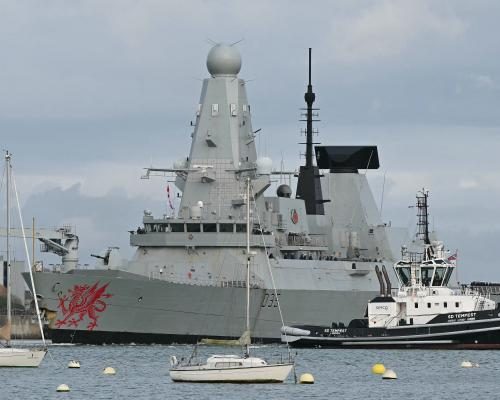
As tensions escalate following the US and Israel's military actions against Iran, the UK's delayed deployment of HMS Dragon off the coast of Cyprus has raised serious questions about the nation's military readiness. More than three weeks have passed since the initial attacks before the British warship, one of only three destroyers available, arrived in the region, illustrating a concerning gap between the UK's military rhetoric and its actual capabilities.
Delayed Response Highlights Military Limitations
HMS Dragon is a symbolic deployment amid rising tensions, having been pulled from dry dock and readied for action only after extensive testing in the Channel. Its arrival has not been officially confirmed, emphasizing the limited military capacity the UK can mobilize in a crisis. Matthew Savill from the Royal United Services Institute noted, "It's clear one of the military's big problems is giving the government contingency options," highlighting the impact of years of budget constraints on military readiness. Originally reported by The Guardian.
The UK has seen a significant reduction in its naval assets, with the number of destroyers and frigates halving since the end of the Cold War. Currently, only 13 are operational compared to 51 at that time. The situation is compounded by political decisions; while the US bolstered its forces in the Middle East, the UK opted for a more cautious approach, deploying only a handful of fighter jets to RAF Akrotiri and Qatar as a precaution against potential Iranian retaliation.
Political Decisions Affect Military Readiness
Keir Starmer's stance has been clear: "This is not our war." A former senior military commander commented on the implications of this decision, stating, "if you've made that decision it colors your deployments elsewhere." The UK's reluctance to engage more robustly in the conflict has left it ill-prepared should the situation escalate dramatically.
The Ministry of Defence has asserted that the decision to deploy HMS Dragon was made only after the fourth day of conflict, coinciding with hostile drone attacks on the UK's base in Cyprus. The attacks prompted evacuations and heightened the urgency for a military response. Although HMS Dragon is the only Royal Navy vessel confirmed for deployment, there are ongoing discussions about potential UK involvement in naval escorts in the Strait of Hormuz, pressured by the US.
Declining Military Capability and Spending Concerns
The UK's military readiness has been questioned further by military experts like former General Richard Barrons, who pointed to a military structure that has been "right-sized" for an era perceived as free of significant threats. With the Armed Forces significantly scaled back, the UK currently spends 2.4% of its GDP on defense, a figure that Labour has pledged to increase to 2.5% by April 2027.
Historically, the UK maintained a fleet of minehunters and a mothership in Bahrain, anticipating potential Iranian threats to the Gulf. However, the recent removal of three minehunters, including HMS Middleton, raises concerns about the UK's preparedness for maritime threats. "We had prepared for this eventuality [the conflict with Iran], but when it happened the UK was not there," a naval officer lamented.
Rhetoric vs. Reality: The Military Capability Debate
Military analysts have expressed frustration over what they describe as the "rhetoric to reality gap," where the UK projects itself as a global power with extensive military capabilities despite evident limitations. Starmer's commitment to leading a stabilization force for Ukraine, amid a dwindling army of just 71,151 personnel, exemplifies the challenges ahead. A potential mission involving 5,000 troops could strain resources significantly, especially if the UK continues its commitments in Estonia.
Critics argue that the Labour government is not effectively leveraging its close ties with the US and lacks a coherent strategy for utilizing hard power. The diminishing role of niche military capabilities, such as minehunting, could further reduce the UK's influence in global military affairs. As public sentiment leans towards non-involvement in the conflict, the government faces a delicate balancing act in addressing its military shortcomings.
As global tensions rise and conflicts evolve, the UK must confront its military readiness and the significant implications of its current capabilities. The ongoing situation in Iran serves as a stark reminder that military strength is not just about rhetoric but requires tangible readiness and effective strategic planning.
Originally reported by The Guardian. View original.