
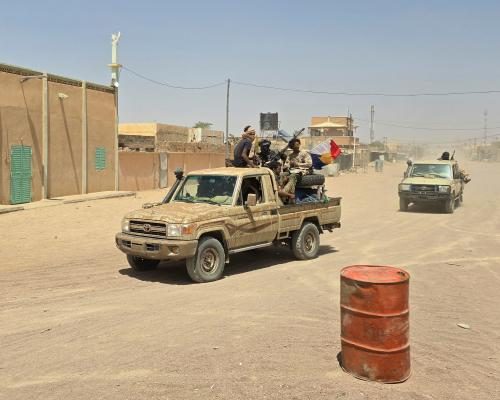
The Russian Defence Ministry has announced that its Africa Corps, the successor to the Wagner Group, successfully thwarted a coup attempt in Mali over the weekend. The ministry claimed that their troops engaged in a fierce battle in the desert town of Kidal, near the Algerian border, for over 24 hours while significantly outnumbered. According to their statement, the engagement resulted in avoiding mass civilian casualties and inflicting 'irreplaceable losses' on rebel forces. However, local reports suggest a starkly different narrative, indicating that the Africa Corps may have negotiated their exit, with Algeria acting as a mediator.
Clash in Kidal and Its Aftermath
Over the weekend, rebel forces in Mali made significant advances, driving the Africa Corps from Kidal and launching an attack near the capital, Bamako. The conflict escalated further with the reported death of Defence Minister Sadio Camara in a suicide bombing, marking a critical blow to the military junta that has leaned on Russian support. The situation has raised serious questions about the effectiveness of Russian military influence in the region. Local officials have claimed that Kidal's governor had warned the Africa Corps of the impending attack three days prior, leading to speculation that their withdrawal was pre-arranged. Originally reported by The Guardian.
"The Russians betrayed us in Kidal," a Malian official stated anonymously, underscoring the growing discontent with Russia's military presence. The fall of Kidal, a city that Russian forces had helped the junta recapture earlier in 2023, reflects the precariousness of Moscow's grip in West Africa. This chain of events comes against a backdrop of increasing violence in Mali, which has been marred by turmoil since a rebellion instigated by Tuareg rebels in 2012.
Russia's Role and Allegations Against Rebels
The Russian Defence Ministry alleged, without providing evidence, that the rebels had received training from European mercenaries, including Ukrainians. While the ministry emphasized the bravery of its soldiers in Kidal, local reports paint a different picture, suggesting that the Africa Corps may not have engaged in a fierce defense as claimed. Military bloggers close to the Russian Defence Ministry reported that a Russian helicopter was downed near Gao, resulting in fatalities among the crew. Footage circulating on social media purportedly shows Russian soldiers involved in clashes with insurgents, with some clips indicating that rebels seized Russian military equipment.
In the days leading up to the conflict, residents around Bamako reported sightings of al-Qaida-affiliated groups such as Jama'at Nusrat al-Islam wal-Muslimin (JNIM) moving freely, raising alarms about the deteriorating security situation. Analysts, including Ulf Laessing, head of the Sahel programme at the German think tank Konrad-Adenauer-Stiftung, believe that the Russian forces could shift their focus southward, prioritizing the defense of the junta while leaving northern territories to rebel control.
Political Fallout and Future Implications
In light of the recent unrest, Kremlin spokesman Dmitry Peskov reiterated Russia's commitment to restoring peace and stability in Mali, emphasizing it as a top priority. Meanwhile, speculation has arisen regarding the whereabouts of Assimi Goïta, the military leader who orchestrated the 2020 coup and has not been seen publicly since the outbreak of violence. The Malian presidency did share a photo of Goïta meeting with Russian ambassador Igor Gromyko, suggesting that he remains active in political discussions despite concerns about his leadership legitimacy.
"Goita has lost his footing.. he no longer has political legitimacy over the junta," a former Malian diplomat indicated, speaking on the condition of anonymity. The political landscape in Mali is becoming increasingly complex, with the junta facing internal divisions and external pressures. As Russian influence appears to wane amid these challenges, the future of security and governance in Mali remains uncertain.
Given the escalating conflict and the shifting dynamics, many observers will be watching closely how the Africa Corps adapts its strategy in the coming weeks. The recent events reveal not just a military struggle but a broader political crisis that could redefine alliances and power structures in Mali and the wider Sahel region.
Originally reported by The Guardian. View original.