
German defense manufacturer Rheinmetall is facing backlash after CEO Armin Papperger's controversial remarks likening Ukraine's drone production to "housewives" cooking in their kitchens. In a recent interview with the Atlantic, Papperger sparked outrage when he suggested that Ukraine's drone technology, while innovative, is not on par with that of established defense giants like Lockheed Martin or Rheinmetall itself.
Papperger's comments were made in response to a question regarding the potential impact of Ukraine's drone industry on traditional military manufacturing sectors, which have historically focused more on tanks and artillery. He dismissed the capabilities of major Ukrainian drone manufacturers, stating, "This is how to play with Legos," and added, "They have 3D printers in the kitchen, and they produce parts for drones. This is not innovation." His remarks quickly drew ire from various quarters, particularly in Ukraine. Originally reported by The Guardian.
Response from Ukrainian Officials and Public Outcry
In the wake of Papperger's comments, Alexander Kamyshin, an advisor to Ukrainian President Volodymyr Zelenskyy, was quick to defend the country's drone industry. He highlighted the crucial role of Ukrainian drones in military operations, particularly their effectiveness against Russian tanks. "In my visits to arms factories, I've seen Ukrainian women working equally with men often enough. They deserve respect," Kamyshin asserted, emphasizing the professionalism and skill involved in drone production.
The controversy gained momentum on social media, leading to the emergence of the hashtag #MadeByHousewives, which became a rallying cry for supporters of Ukraine's defense efforts. Ukrainian Prime Minister Yulia Svyrydenko weighed in on the debate, stating that the people of Ukraine deserve not only respect but also a platform to be heard. "Yes, Europe's defense is powered by Ukrainian 'housewives,'" she added, further promoting the hashtag.
Rheinmetall's Efforts to Mitigate Fallout
In an attempt to mitigate the fallout from Papperger's remarks, Rheinmetall issued a statement on social media, reaffirming its respect for the Ukrainian people's efforts in their ongoing defense against Russian aggression. "We have the utmost respect for the Ukrainian people's immense efforts in defending themselves. Every single woman and man in Ukraine is making an immeasurable contribution," the company stated, tagging Kamyshin in the post.
This clarification, however, did little to quell the outrage, as many still viewed Papperger's comments as dismissive of the significant contributions made by Ukrainian civilians, particularly women, in the face of war. The ongoing conflict has seen a remarkable mobilization of various sectors of society, including women, who have taken on vital roles in the defense industry.
Continued Military Conflict and Strategic Partnerships
Meanwhile, President Zelenskyy is actively seeking to strengthen Ukraine's military partnerships amid ongoing hostilities. On Sunday, he discussed a potential security partnership with Jordan's King Abdullah, focusing on combating drone attacks that have become increasingly prevalent due to the conflict in the region. Zelenskyy expressed the need for a unified security system to protect critical infrastructure and civilians, drawing from Ukraine's own experiences over the past four years.
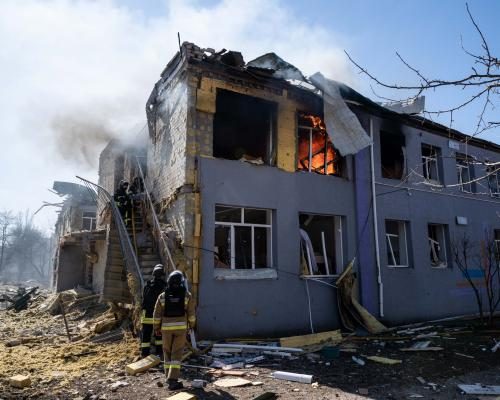
"From our own experience, we know that without a unified system, it is simply impossible to set up full-fledged protection of people and critical infrastructure," he noted on Telegram. The urgency of these discussions is underscored by recent Russian strikes on Ukrainian cities, including Kramatorsk, which claimed three lives and injured 13 others.
Escalating Attacks and Defense Strategies
As the conflict escalates, both sides are ramping up military capabilities. On Sunday, Kramatorsk was hit again just hours after the initial attack, highlighting the ongoing volatility in frontline areas. Additionally, Ukrainian drone strikes have targeted Russian facilities, including a recent assault on the Baltic port of Ust-Luga, disrupting Russia's oil supply and causing significant damage.
The Ukrainian Security Service (SBU) reported that long-range drones successfully struck an oil terminal at Ust-Luga, leading to a substantial fire and damage to infrastructure. This follows a series of drone strikes that have targeted key Russian energy facilities, contributing to a notable spike in oil prices, which recently surpassed $100 a barrel.
As the war continues and the stakes rise, the implications of Papperger's comments serve as a reminder of the complexities surrounding the defense industry, public perception, and the evolving nature of warfare.
Originally reported by The Guardian. View original.