
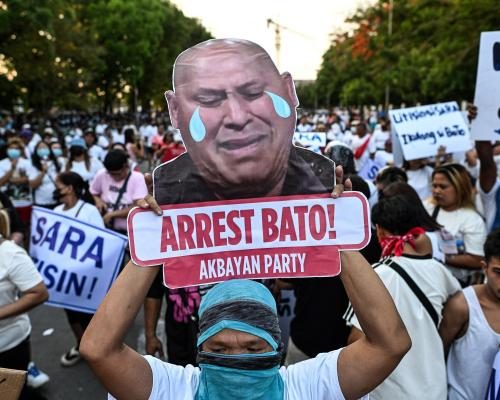
Philippine authorities are currently investigating reports that Senator Ronald dela Rosa, wanted by the International Criminal Court (ICC), has fled the Senate premises after evading capture. According to Clare Castro, a presidential communications undersecretary, officials are working to confirm the senator's whereabouts following allegations he escaped the heavily fortified Senate building undetected in the early hours. "We are still getting official confirmation," Castro stated during a press conference, noting that no operations had been initiated to apprehend him thus far.
Dela Rosa, who previously served as the head of the Philippine National Police under former President Rodrigo Duterte, is facing charges related to his role in overseeing the controversial anti-drug campaign that left thousands dead. Reports suggest he had been avoiding arrest for several days, having dramatically outrun government agents and sought refuge in the Senate, where he received protective custody from allies. Originally reported by The Guardian.
Gunfire Erupts Amid Senate Tensions
The situation escalated further on Wednesday night when gunshots were fired within the Senate chamber, causing panic among journalists and attendees. Dela Rosa had earlier warned that his arrest was imminent, urging supporters to gather outside the Senate to act as a protective barrier. Following the incident, Philippine President Ferdinand Marcos Jr. stated that no government personnel were involved in the shooting and questioned whether the episode was an attempt to destabilize the government.
Authorities have launched an investigation into the shooting. Police spokesperson Brigadier-General Randulf Tuano confirmed that one individual had been detained in connection with the incident, apprehended on the second floor of the Senate building. Interior Secretary Juanito Victor Remulla revealed that Senate security discharged "warning shots" at unidentified armed individuals who had reportedly ascended the Senate stairway.
Background on Dela Rosa's ICC Charges
Senator Ronald dela Rosa is one of eight individuals named by the ICC in its case against Duterte, who is currently in custody at The Hague. The ICC has issued an arrest warrant against dela Rosa, accusing him of "authorising, condoning and promoting" killings associated with the drug war, as well as providing weapons, promising impunity, and rewarding those who carried out these acts. The warrant was unsealed earlier this week, intensifying scrutiny on the senator's actions during his tenure with the National Police.
Despite the gravity of the allegations, Dela Rosa has denied any wrongdoing. His role in the Duterte administration's brutal anti-drug campaign has come under severe criticism both domestically and internationally, with human rights advocates claiming that the operations resulted in extrajudicial killings and severe violations of human rights.
Political Implications and Public Response
The unfolding drama in the Senate has not only raised questions about the efficacy of law enforcement in the Philippines but also highlighted the tense political climate under the Marcos administration. Observers worry that the incident may signal deeper instability within the government. President Marcos's remarks about potential destabilization efforts raise concerns about the motivations behind the gunfire and the ongoing public support for dela Rosa.
Public sentiment regarding the anti-drug campaign remains divided. While some support the hardline approach to crime, others express alarm over the numerous deaths and the erosion of legal protections for the accused. As the situation develops, how the government handles this incident and the broader implications of Dela Rosa's potential legal troubles will likely shape public discourse around justice and governance in the Philippines.
As authorities continue to investigate Dela Rosa's escape and the gunfire incident, the international community is watching closely. The outcome could have significant ramifications for the Philippines' political landscape, particularly in the context of human rights and accountability for past actions. With the ICC's involvement, the pressure is mounting on the Philippine government to address these serious allegations comprehensively and transparently.
Originally reported by The Guardian. View original.