
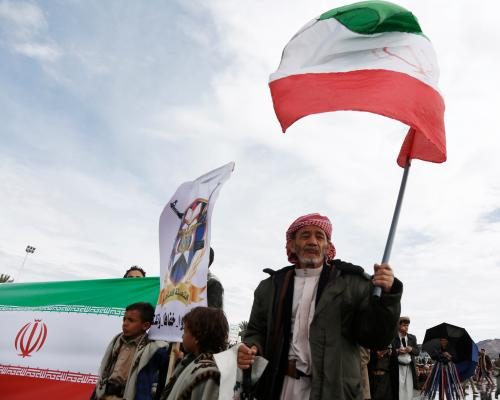
The Houthis, a Tehran-backed group from Yemen, have officially entered the Iran war, a shift that could have profound implications for both the conflict and regional stability. Their strategic position near the Bab al-Mandab strait allows them to potentially disrupt shipping in the Red Sea, mirroring Iran's influence over the Strait of Hormuz. The outcome of this involvement hinges on whether the Houthis will launch missiles toward Israel or focus on blocking maritime traffic, a move that could devastate global commerce.
Strategic Maritime Implications
Historically, the Bab al-Mandab strait serves as a crucial artery for international shipping, connecting the Red Sea to the Gulf of Aden. Should the Houthis choose to exert their influence here, they could effectively choke off a significant portion of maritime trade. This would have a ripple effect on global shipping costs, oil prices, and economic stability. Farea Al-Muslimi, a Middle East specialist at Chatham House, warned that sustained disruption in this region would drive up shipping costs and increase oil prices, exacerbating strains on a global economy already burdened by tensions in the Strait of Hormuz. Originally reported by The Guardian.
Iran's strategy of leveraging allied groups, like the Houthis, to expand its influence in the region is becoming increasingly apparent. The Houthis' potential to interfere with commercial shipping raises concerns about the broader implications for trade routes and economic repercussions worldwide. Napoleon Bonaparte once said, "the policy of a state lies in its geography," a sentiment that resonates with the current geopolitical landscape.
Recent Developments and Ceasefires
Since gaining control of large areas of Yemen, including the capital, Sanaa, in 2014, the Houthis have established themselves as a resilient force despite facing significant setbacks. Notably, in August 2025, Israel executed a targeted strike that killed key Houthi leaders, including their prime minister. However, Israel has struggled to locate Abdul Malik Al-Houthi, the movement's leader, and has yet to engage directly with the Houthis on Iran's behalf, despite evidence linking their arms to Tehran.
A ceasefire brokered by Oman with the United States has been in effect since May 2025, halting attacks on U.S. shipping through the Bab al-Mandab - attacks that had escalated since October 2023. However, the Houthis have made it clear that this ceasefire does not extend to Israel, continuing to launch attacks targeting Israeli interests. This situation reflects an Iranian desire to create political momentum ahead of renewed nuclear talks with the U.S. in the spring of 2025, as the Houthis extended their ceasefire to Israel in October 2025 following a separate ceasefire agreement between Israel and Hamas.
Saudi Arabia's Role and Regional Dynamics
With Saudi Arabia emerging as the primary power broker in Yemen, the dynamics of the conflict have shifted significantly. The Saudis recently quashed the southern separatist movement led by the Southern Transitional Council (STC), which had been supported by the UAE. This strategic maneuver leaves Riyadh in a precarious position, needing to navigate relations not only with the Houthis but also with the remnants of the STC, which, despite officially disbanding, still claims to represent the southern cause.
As Saudi Arabia invests heavily in the new southern government, the Houthis may see an opportunity to negotiate for financial assistance in exchange for maintaining peace and avoiding disruption of shipping routes. Riyadh cannot afford to engage on multiple fronts simultaneously, making it likely they will seek backdoor negotiations with the Houthis to minimize the threat of attacks in the Red Sea.
The Humanitarian Consequences
The ongoing conflict and potential escalation involving the Houthis threaten to exacerbate an already dire humanitarian situation in Yemen, which has been ravaged by civil war for over a decade. Hans Grundberg, the UN special envoy for Yemen, warned that this escalation risks dragging Yemen further into the regional war, complicating efforts to resolve the conflict and prolonging the suffering of civilians. His comments underscore the urgent need for diplomatic solutions as the stakes continue to rise.
As the Houthis navigate their next steps in this complex geopolitical arena, the possibility of their involvement in the Iran war looms large. Whether they choose to target Israel or disrupt shipping routes could determine not just their future but also the stability of the entire region. The world watches closely as these developments unfold, with significant implications for global trade and security.
Originally reported by The Guardian. View original.