
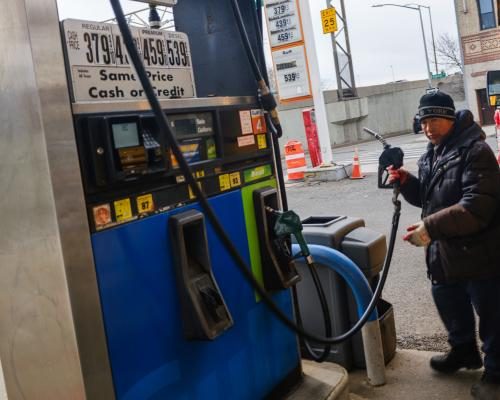
The ongoing conflict involving the US-Israel alliance and Iran is sending shockwaves through American households, driving up everyday living costs. Following recent military strikes on Iran, retaliatory actions targeting US allies have unfolded, leading to a significant spike in prices across various sectors. Gas prices have surged approximately 30% nationwide over the past month, leaving many Americans struggling to make ends meet.
Surging Costs Hit Everyday Americans Hard
In the wake of the US-Israeli military actions, economic repercussions are being felt acutely by everyday citizens. The conflict has prompted Iran to close the Strait of Hormuz, a vital maritime route, further exacerbating supply chain issues and driving up costs. Alongside the spike in fuel prices, grocery bills, mortgage rates, and the prices of essential goods like fertilizer have also increased dramatically. Originally reported by The Guardian.
A bank employee from Minneapolis, Lore, shared his experience of adapting to the rising costs. "I'm driving less.. I'm also saving money because my 2012 Mazda is getting old and I'm holding on to it for as long as possible," he explained. With public transportation in Indianapolis being less than ideal, Lore is concerned about potential car repairs, recalling a recent $1,500 bill that he can ill afford to repeat.
Families Struggle to Balance Work and Expenses
For many families, the financial strain has become overwhelming. A librarian from Massachusetts noted that her husband has taken on extra shifts in a delivery job to help cover rising costs. "He currently works a delivery job where he uses his own vehicle and has to pay for gas that isn't fully reimbursed by his employer," she explained. They are facing a barrage of expenses, from skyrocketing fuel prices to exorbitant rent, leaving them with little hope for the future. "Forget retirement, I'm worried we won't even be able to make it through the next few years," she added, highlighting the unsustainable nature of their current financial situation.
Elizabeth, another librarian from Indiana, echoed similar sentiments regarding the rising costs of energy and daily necessities. "A tank of gas for my car used to be maybe $30, but the last time I filled up it was closer to $45," she stated. With mounting utility bills and deferred home repairs, she worries about the future and how to sustain her household as costs continue to rise.
The Impact on Small Business Owners
Small business owners are not immune to these economic pressures. A tattoo artist and father from Pennsylvania recently closed his private studio due to decreasing demand, attributing the downturn to the financial strain on consumers. "I've worked through one recession already and have no interest in struggling through another," he remarked, noting that tattoos are considered luxury items. He has since taken a job at a quick-service restaurant, revealing the harsh realities many small business operators are facing in this economic climate.
Amidst these Struggles, concerns about health care continue to loom large for many workers. A bread factory employee in Michigan described the anxiety of navigating his daily commute. "I'm concerned for my health, the possibility that my medication may stop working and I start having seizures again," he shared, detailing the risks associated with his walk to work in poorly lit areas. The fear of losing access to crucial medical care is palpable among those already feeling the weight of financial instability.
Widespread Anxiety and Uncertainty
The stories from across the nation paint a grim picture of widespread anxiety and uncertainty. An elderly woman working in a New York law library described her frugal lifestyle, emphasizing the constant struggle to keep up with rising costs. "Money is very, very tight. My furnace died in February and I was forced to sign a loan agreement to pay on that monthly," she recounted, highlighting the sacrifices she's made to simply get by.
As the conflict in Iran continues to unfold and economic pressures mount, many Americans are left wondering how they will navigate these challenges. The collective concern over finances, health care, and the future is palpable, leaving individuals and families feeling as though they are on the brink of a crisis. With essential costs rising and no end in sight, the path forward remains uncertain.
As the situation evolves, the economic ramifications of the conflict will likely continue to ripple through American households, forcing many to make difficult choices about their finances and future.
Originally reported by The Guardian. View original.