
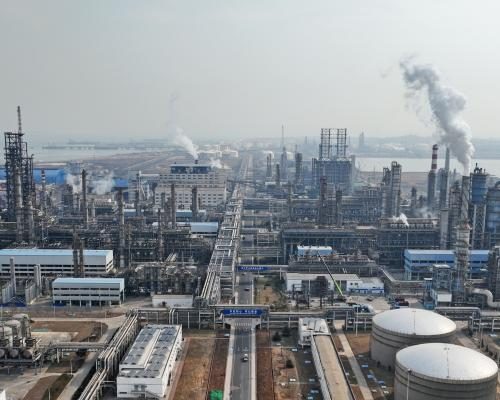
In the bustling province of Shandong, China's independent oil refineries, known as "teapots," are facing unprecedented challenges amid soaring global crude prices. These smaller refineries, which constitute about a quarter of China's refining capacity, play a vital role in the country's energy security, particularly as energy crises ripple across Asia. As geopolitical tensions rise and crude prices skyrocket, the teapots are navigating a precarious landscape.
Quiet Towns with a Vital Role
The towns supporting China's energy framework often appear deceptively quiet. Oil trucks navigate wide-open highways, and boarded-up shops hint at a decline in local economic activity. A noodle shop, typically busy during lunch, barely sees customers except for a few construction workers and a teacher engrossed in social media. However, the shop's owner remains optimistic, noting that midnight is peak time when refinery workers flood the streets after their shifts. Originally reported by The Guardian.
Shandong's teapot refineries are essential to maintaining the region's economic stability. Unlike larger state-owned enterprises elsewhere in China, these smaller, independent refineries thrive on tight margins, sourcing inexpensive crude oil to produce gasoline and diesel for surrounding provinces. The importance of these operations has intensified as energy crises grip other parts of Asia, with disruptions leading to school closures in Pakistan and national emergencies declared in the Philippines.
Teapot Refineries and Global Crude Trends
Oil, while comprising less than a fifth of China's overall energy mix, remains crucial for the country's economy, particularly in transportation. The recent crisis, triggered by US-Israel military actions against Iran on February 28, has sent shockwaves through the oil market, with Iranian oil flows continuing unabated to China. Reports indicate that China imports over 80% of Iranian crude, amounting to approximately 1.6 million barrels per day, a rise from 1.4 million barrels per day in 2025.
According to Muyu Xu, a senior crude oil analyst at Kpler, there's been no disruption to these Iranian oil shipments. Unlike state-owned refiners, which are hesitant to engage with Iranian oil due to the risk of sanctions from the US, the teapot refineries face no such constraints. Erica Downs, a senior research scholar at the Center on Global Energy Policy at Columbia University, noted that while some teapots were sanctioned under the Trump administration, the overall flow of Iranian oil to China has remained steady, with Western sanctions inadvertently benefiting Iran and its allies, including Russia and Venezuela.
Local Impact of Rising Prices
The consequences of rising crude prices are palpable across Shandong. Uncle Wang, a petrol station owner in Weifang, shared that while local fuel supplies have remained stable, escalating prices have severely squeezed profit margins to nearly zero. "It's not that [other countries] can't get oil, it's that they are too scared to buy it because [Donald] Trump won't let them. But China isn't afraid of him," he stated, reflecting the local sentiment amidst global volatility.
Similarly, workers at Luqing Petrochemical, one of Shandong's prominent teapots, are feeling the pinch. A 22-year-old worker expressed concerns about the war's impact on business. With crude prices surging, clients are purchasing less, leading to anticipated reductions in monthly earnings. "Before the war, profits were OK. After the war started, because the crude oil prices went up so much.. clients started buying less," he said, emphasizing the trickle-down effects of geopolitical events on local economies.
Future Prospects and Challenges
As the global demand for oil intensifies, Shandong's teapot refineries find themselves in a precarious position. The price disparity between Iranian light crude and Brent crude has narrowed significantly, with the discount reducing from approximately $11 per barrel before the crisis to just $2. This shift comes as Brent prices have soared, further complicating the operational landscape for these essential refineries.
The future of China's teapot refineries hangs in the balance, dependent on fluctuating global oil prices and geopolitical dynamics. While they play a critical role in stabilizing the domestic market, the rising costs and decreasing profit margins pose significant threats to their sustainability. As the world watches, these small yet vital players in China's energy sector continue to navigate turbulent waters, striving to maintain their pivotal role in the nation's economy.
Originally reported by The Guardian. View original.