
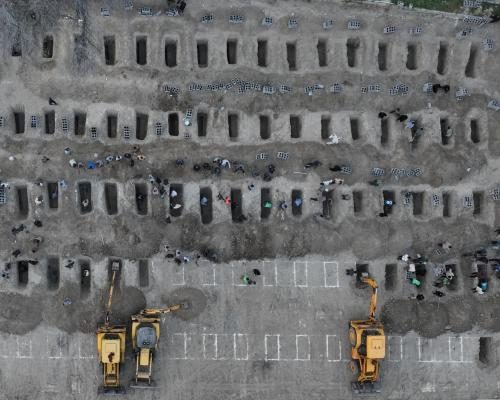
Amid the ongoing US-Israeli conflict in Iran, a haunting photograph depicting freshly dug graves for over 100 young girls in Minab has sparked intense debate regarding its authenticity. While some AI platforms assert the image is an old stock photo from a different disaster, investigations confirm it is indeed genuine, highlighting the complexities of verifying information in a digital age rife with misinformation.
Graveyard Image Captures Global Attention
The photograph in question shows a graveyard in Minab, Iran, where rows of freshly dug graves await burial of the town's young girls, victims of escalating violence. The graves are arranged in neat lines, with more than 60 already excavated, while workers stand ready to continue their grim task. This stark image has resonated globally, serving as a powerful symbol of the tragic human cost of war. Originally reported by The Guardian.
However, the authenticity of the photo has come under scrutiny. AI services, such as Google's Gemini and X's Grok, have claimed that the image is misattributed. Gemini asserts that the image is actually from Kahramanmaraş, Turkey, depicting mass burials following a devastating earthquake in 2023, while Grok identifies it as a stock photo from Rorotan Cemetery in Jakarta, Indonesia, related to Covid-19 burials in July 2021. Both AI platforms provide seemingly credible references to support their claims.
AI Misidentifications Complicate Truth Verification
Despite the confidence of these AI assessments, investigation reports have found them to be incorrect. Researchers have cross-referenced the Minab graveyard image with satellite imagery and other photographic evidence, confirming its authenticity. The findings reveal no signs of digital manipulation, exposing the inaccuracies of the AI-generated claims.
This incident exemplifies a troubling trend in the landscape of information dissemination. Experts are increasingly observing a surge in AI-generated misinformation, particularly related to the Iran conflict. Shayan Sardarizadeh, a senior journalist at the BBC Verify team, notes that the volume of falsehoods attributed to generative AI has surged, now comprising nearly half of all viral misinformation tracked by the organization. This shift complicates the already challenging task of verifying facts in a war zone.
AI's Role in News Summarization and Misinformation
As AI tools for news summarization gain traction, the risk of misinformation increases. With platforms like Google AI and Grok becoming widespread since their public rollout in mid-2024, 65% of users report regularly encountering AI-generated news summaries. However, a 2025 international study found that nearly half of these summaries contained significant accuracy issues, with some AI tools reporting up to 76% inaccuracies.
The reliance on AI for news consumption rather than consulting original sources raises alarm bells among researchers and journalists. As AI tools become more prevalent, the potential for disseminating misinformation grows, with serious implications for public understanding of critical events such as the Iran war. The graveyard image from Minab is just one example of how misinformation can proliferate in an increasingly digital world.
A Closer Look at Misinformation Trends
The Minab graveyard controversy is part of a broader pattern of misinformation that has emerged since the conflict began. Other examples include a photo misrepresented as satellite imagery of a destroyed US radar in Qatar, which turned out to be an AI-generated fake, and widely circulated images purportedly showing Iranian leadership casualties that contained clear indicators of manipulation, such as duplicate limbs among rescuers.
These instances highlight the challenges that fact-checkers face in the current media landscape. As AI-generated content becomes more sophisticated, distinguishing between authentic and fabricated images requires advanced forensic techniques. The rise in AI misinformation not only consumes valuable investigative resources but also poses a risk of obscuring real atrocities and undermining trust in media.
The reliance on AI for news is a double-edged sword. While it can streamline information access, it can also lead to the spread of inaccuracies that can shape public perception and policy. As users increasingly turn to AI for news updates, the need for robust verification processes has never been more crucial.
Originally reported by The Guardian. View original.