
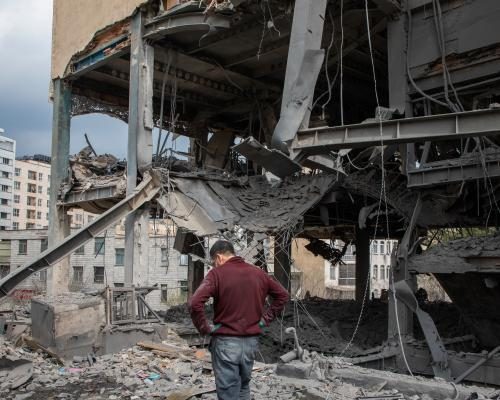
Amid escalating tensions in the Middle East, former U.S. President Donald Trump has expressed a desire to seize Iranian oil and suggested that U.S. forces could easily capture Kharg Island, Iran's primary oil export hub. This statement comes as Israel intensifies its military operations against Iranian infrastructure in Tehran, further complicating the already volatile situation in the region.
Israeli Military Operations Intensify
The Israeli military reported on social media platform X that it is currently targeting the Iranian regime's infrastructure across Tehran. The announcement was brief and lacked specific details, but it highlights Israel's ongoing military engagement in the region. This development follows a tragic incident involving an Indonesian peacekeeper who lost their life while serving with the United Nations Interim Force in Lebanon (UNIFIL). The peacekeeper was killed when a projectile struck their position near the village of Adchit al-Qusayr. Indonesia's foreign ministry condemned the attack, stating that any harm to UN peacekeepers is unacceptable and reiterated its call for respect for Lebanon's sovereignty amidst the ongoing conflict. Originally reported by The Guardian.
Global Economic Impact of Middle East Conflict
As geopolitical tensions rise, South Korean airlines have requested government assistance to redirect jet fuel exports to their domestic market. This comes in the wake of China's recent restrictions on fuel exports, which threaten to disrupt critical supply chains and impact countries like Australia, which relies on South Korea for about a quarter of its refined fuel imports. Currently, Australia sources 18% of its total jet fuel imports from South Korea. With reports indicating that China has limited its fuel exports, concerns are mounting about the potential fallout from the Middle East conflict on global fuel prices and availability.
The price of Brent crude oil has surged past $116 per barrel, a steep increase from just over $70 per barrel when hostilities began last month. The closure of the Strait of Hormuz by Iranian forces has contributed to rising costs for oil, gas, fertilizers, and other essential commodities. Market analysts warn that inflation is likely to spike, with many Asian economies particularly vulnerable due to their dependence on Middle Eastern energy supplies. Japan's Nikkei index dropped another 4.7%, while South Korea's market fell 4.2%. The economic repercussions of the conflict echo worldwide, as investors brace for the possibility of a prolonged crisis.
Trump's Controversial Oil Seizure Remarks
In a recent interview with the Financial Times, Donald Trump stated his preference to seize Iranian oil, asserting that U.S. forces could capture Kharg Island with relative ease. Trump drew parallels between the potential seizure of Iranian oil and the U.S. strategy in Venezuela, where the U.S. has aimed to control the oil industry following the ousting of President Nicolás Maduro. "To be honest with you, my favorite thing is to take the oil in Iran, but some stupid people back in the U.S. say: 'why are you doing that?' But they're stupid people," Trump declared.
This bold statement raises significant questions about the feasibility and implications of such military actions. Capturing Kharg Island, through which a substantial portion of Iran's oil is exported, could indeed provide the U.S. with leverage over Iran. However, such an operation would also entail considerable risks, including the potential for increased U.S. military casualties and an extended conflict. Trump noted, "Maybe we take Kharg Island, maybe we don't. We have a lot of options." He also mentioned that indirect talks between the U.S. and Iran via Pakistani intermediaries are reportedly progressing well, suggesting that diplomatic avenues remain open amidst the military posturing.
International Diplomatic Efforts Amidst Conflict
As military actions escalate, international diplomatic efforts are also ramping up. Pakistan's foreign minister announced that the country would soon host talks between U.S. and Iranian officials. This announcement comes as top diplomats from Pakistan, Saudi Arabia, Turkey, and Egypt convene in Islamabad to discuss strategies for de-escalating the ongoing war. While neither Washington nor Tehran has publicly commented on these upcoming discussions, they represent a potential path toward reducing tensions in a region increasingly fraught with conflict.
As the situation in the Middle East continues to evolve, the ramifications of military strategies and diplomatic negotiations will undoubtedly shape the geopolitical landscape and influence global markets in the weeks and months to come.
Originally reported by The Guardian. View original.