
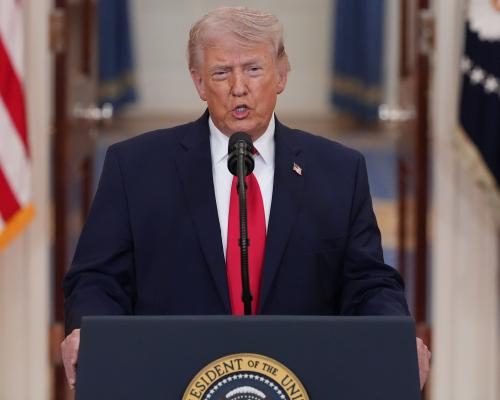
In a prime-time address, President Donald Trump outlined his administration's stance on the ongoing conflict in Iran, emphasizing the country's alleged proximity to nuclear capability. With recent polling indicating waning support for the war, Trump sought to bolster confidence in his strategy, amid mounting casualties across the Middle East.
Trump's Nuclear Claims and Military Actions
During his address, Trump asserted that Iran is "right at the doorstep" of acquiring a nuclear weapon. He dismissed concerns regarding Iran's stockpile of highly enriched uranium (HEU), arguing that it lies deep underground and is subject to satellite monitoring. Experts have warned that if the current US-Israeli military operations leave the Iranian government in control of its 440 kg of HEU, Tehran's ability to develop nuclear warheads would increase significantly. Originally reported by The Guardian.
Trump reiterated his long-standing position against Iran's nuclear ambitions, stating, "From the very beginning of my campaign for president in 2015, I said I would never allow Iran to have a nuclear weapon." He pointed to recent military successes, claiming, "Iran's navy is gone. Their Air Force is in ruins.. Very few are left." In addition, Trump referenced the operation aimed at removing Venezuelan leader Nicolás Maduro, reinforcing his administration's commitment to combating regimes he views as adversarial.
Waning Public Support for Military Action
As Trump prepared for his address, a CNN poll revealed that only one-third of Americans believe he has a "clear plan to handle the situation in Iran." Public approval for the war has also dropped, with just 34% of respondents supporting the decision to initiate military action-down seven percentage points from earlier polling conducted shortly after the conflict began on February 28.
The conflict has resulted in over 5,000 deaths across the region, with the majority of casualties reported in Iran and Lebanon. The Iran Human Rights Activists News Agency (HRANA) reported that 3,519 individuals have died since the war's outbreak; among them, 1,598 were civilians, including at least 244 children. In Lebanon, authorities confirmed that Israeli strikes have killed 1,318 people since March 2, with a significant number of fatalities among Hezbollah fighters.
Ongoing Military Operations and International Relations
US Central Command provided an update on Operation Epic Fury, revealing that more than 13,000 combat flights have targeted over 12,000 sites, damaging or destroying more than 150 Iranian vessels. Despite these aggressive military actions, Trump's administration faces difficulties in communicating a coherent strategy. Reports indicate that US intelligence agencies believe Iran is not currently open to negotiations, as Tehran perceives itself to be in a strong position despite the military campaign.
Compounding the situation, Iranian officials have denied Trump's claims that their leadership sought a ceasefire. The Iranian president, Masoud Pezeshkian, previously stated that while Iran possesses the "necessary will" for a ceasefire, such a resolution is contingent on assurances that hostilities will not resume. This complexity has contributed to a volatile and uncertain climate in the region.
Humanitarian Crisis and Global Repercussions
The humanitarian toll continues to escalate, with various organizations highlighting the plight of civilians caught in the crossfire. HRANA's reports indicate that the situation remains dire, particularly in Iran where civilian casualties are mounting. The international community is increasingly concerned about the implications of the war, as it spills over into neighboring countries, including Syria, Iraq, and Israel, further destabilizing the region.
The United Nations has yet to secure a lasting peace, and the conflict shows no signs of resolution. As the violence continues, more families are being displaced, and the already fragile infrastructures in affected areas are under severe strain. It remains uncertain how the international community will respond to the growing humanitarian crisis and whether diplomatic efforts will emerge as a viable alternative to military engagement.
As President Trump's administration grapples with these challenges, the path forward will likely hinge on both military strategy and diplomatic negotiations, raising critical questions about the future stability of the Middle East.
Originally reported by The Guardian. View original.