
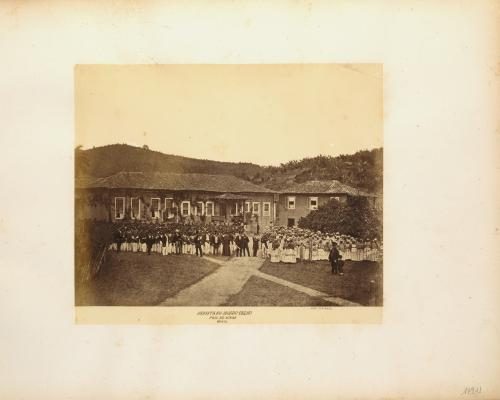
In 1845, while Britain had officially abolished slavery within its own borders, British companies were still profiting from enslaved people in Brazil. The St John d'El Rey mining company "rented" 385 captives, a practice that exploited legal loopholes to continue benefitting from slavery even after the UK Slavery Abolition Act of 1833. This case exemplifies the intricate relationship between British commercial interests and Brazilian slavery, a connection that historian Joseph Mulhern argues is often overlooked.
Legal Loopholes and Enslavement
The year 1845 was pivotal for British citizens and companies as they were prohibited from owning or purchasing enslaved people overseas. However, the St John d'El Rey mining company circumvented this law by "transferring" 385 enslaved individuals under a rental agreement. The Slave Trade Act of 1843 allowed such arrangements, making the company's actions technically legal, despite the ongoing global campaign against slavery led by the UK. Originally reported by The Guardian.
Although a maximum rental term of 14 years was stipulated, the enslaved individuals were never freed after this period expired. The British ambassador to Brazil became aware of the situation but, citing insufficient evidence, chose to ignore it. It wasn't until decades later, in 1879, that Brazilian abolitionist Joaquim Nabuco brought the plight of the 123 survivors to light, but by then, a substantial majority had perished in captivity.
British Involvement in Brazilian Slavery
Mulhern's recent publication, British Entanglement with Brazilian Slavery - Commerce, Credit and Complicity in Another Empire, c. 1822-1888, highlights how British merchants and banks played a crucial role in the continuation of slavery in Brazil. He notes that while the UK pressured Brazil to ban the trafficking of enslaved Africans in 1831, this law was widely ignored, leading to its characterization as a measure "for the English to see."
British merchants supplied goods and long-term credit that enabled traffickers to operate illegally. As Mulhern explains, "British officials in Brazil and their superiors in London were all too aware of the intricate connections between British commercial interests and the Brazilian slave trade." The legal trafficking of enslaved individuals persisted until 1850, when a new law finally curtailed the practice, albeit after approximately 750,000 Africans had been illegally brought to Brazil since 1831.
Financial Institutions and Their Role
Mulhern's research reveals that British financial institutions were deeply entwined with slavery, treating enslaved individuals as collateral assets for loans and mortgages. When debtors defaulted, banks forced auctions to recover their capital. This inhumane practice was exemplified by the case of Caetana, a 22-year-old mother who was separated from her three-year-old son during an auction in Rio de Janeiro in 1878.
Additionally, a rare census commissioned by Britain's Foreign Office in 1848 and 1849 documented 3,445 enslaved individuals held by British interests in Brazil. Over half of these individuals were owned by companies such as St John d'El Rey, which continued operating until 1985. This stark reality starkly contrasts the narrative of benevolence often attributed to British slave owners, a myth that Mulhern thoroughly debunks in his work.
Legacy of Abolition and Historical Amnesia
The scandal surrounding the rented enslaved individuals significantly contributed to the abolition of slavery in Brazil in 1888, making the country the last in the Americas to do so. Despite the prominent role of British companies, the narrative surrounding British involvement in slavery often leans toward self-congratulatory tones. Mulhern highlights the need for a more nuanced understanding of this history, stating, "These connections [between the UK and Brazilian slavery] are very much overlooked."
Even small traders and impoverished British immigrants were involved in the enslavement of individuals, challenging the notion that only wealthy landowners profited from slavery. This complex history serves as a reminder that Britain's role in the transatlantic slave trade is not merely a chapter of the past but an intricate web of connections that extend into modern narratives about morality and justice.
As discussions around reparations and historical responsibility continue, acknowledging the full extent of British involvement in slavery and its ramifications becomes increasingly important. The legacy of profit from slavery in Brazil is a crucial part of understanding both historical and contemporary socio-economic disparities.
Originally reported by The Guardian. View original.