
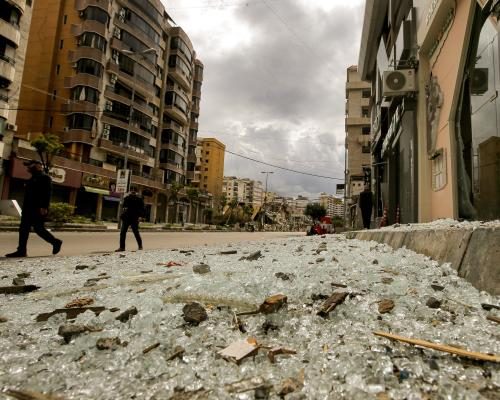
In a dramatic escalation of hostilities, the Israeli military reported missile attacks originating from Iran on Thursday, prompting air defense systems to activate across central Israel, parts of Jerusalem, and the occupied West Bank. The military confirmed in two statements, spaced about 20 minutes apart, that they had identified missiles launched from Iran targeting Israeli territory. "Defensive systems are operating to intercept the threat," the military announced, according to Agence France-Presse.
Following the initial missile strike, the Israeli military advised citizens that they could leave protected spaces throughout the country. Fortunately, reports from Israel's Magen David Adom emergency medical service indicated that there were no immediate casualties from the attacks. This latest incident comes just over 14 hours after the military had previously reported incoming missiles from the Iranian side. Originally reported by The Guardian.
Hezbollah Involvement and Ongoing Conflict
The situation in Israel is further complicated by recent hostilities involving Hezbollah, which has fired rockets targeting Israeli military sites from Lebanon. Israeli media reported that six rockets were intercepted during these attacks. As tensions mount, the Israeli military has also engaged in ground fighting with Hezbollah forces in Southern Lebanon, with plans to establish a "defensive buffer" up to the Litani River, approximately 30 kilometers from the border.
This escalation is part of a broader conflict that has seen Israel conduct extensive airstrikes against Hezbollah positions across Lebanon. The Israeli military confirmed that a soldier was seriously injured in mortar fire while engaging in operations against Hezbollah, highlighting the ongoing volatility in the region. Videos posted by soldiers show their advancement into previously contested towns, underscoring the military's determination to gain ground despite fierce resistance.
Trump's Diplomatic Maneuvering Amidst Hostilities
In the United States, former President Donald Trump has claimed that American officials are engaged in "strong talks" aimed at resolving the ongoing war with Iran. His remarks came shortly before Qatar's foreign ministry distanced itself from the alleged diplomatic negotiations, with spokesperson Majed al-Ansari stating that Qatar was not involved in mediation efforts. This marks a significant departure from Qatar's traditional role as a mediator in regional conflicts.
Analysts have suggested that Qatar and other Gulf nations are exhibiting reluctance to support these purported ceasefire efforts, largely due to the heavy toll the ongoing conflict has taken on their countries. Bilal Saab, a senior managing director at advisory group Trends US and a former Pentagon official, noted that these nations have been "burned by their previous experience" in negotiations, leading to a sense of frustration and disappointment that complicates their willingness to mediate.
International Reactions and Market Implications
As the situation continues to unfold, global markets have reacted with caution. Asian stocks mostly fell, with Tokyo's Nikkei 225 down 0.3%, South Korea's Kospi losing 1.9%, and Hong Kong's Hang Seng dropping 1.4%. Meanwhile, oil prices experienced an uptick, with Brent crude rising 1.3% to $98.51 per barrel, while benchmark US crude climbed 1.6% to $91.75 per barrel. The increase in oil prices follows Tehran's dismissal of a ceasefire proposal from the US, indicating that tensions are unlikely to ease in the near term.
China has expressed a cautious optimism regarding the potential for dialogue, with foreign minister Wang Yi stating that a "glimmer of hope" for peace has emerged. He urged for dialogue in separate discussions with both Turkish and Egyptian counterparts, suggesting that signals from Washington and Tehran indicate a willingness to negotiate. However, Iranian Foreign Minister Abbas Araghchi countered this optimism, asserting that no negotiations had taken place, framing discussions of talks as an admission of defeat.
The unfolding crisis in the Middle East, characterized by missile exchanges and international diplomatic wrangling, underscores the precarious balance of power in the region. As hostilities continue and both military and diplomatic fronts evolve, the prospects for peace remain uncertain. Stakeholders around the globe will be watching closely as developments unfold, hoping for a resolution amid the mounting tensions.
Originally reported by The Guardian. View original.