
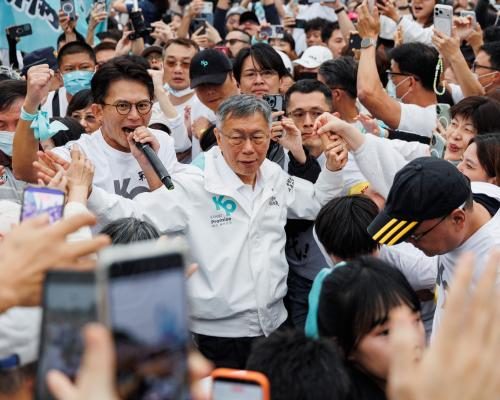
Taiwan's political landscape shook this weekend as opposition leader Ko Wen-je rallied tens of thousands of supporters outside the Presidential Office in Taipei, just two days after receiving a 17-year prison sentence on corruption charges. "I will not yield! I will not surrender!" Ko declared to a crowd estimated at 80,000, turning to face the historic red-brick building that houses the presidency. His message was clear: opposition to President Lai Ching-te and the ruling Democratic Progressive Party (DPP) remains strong.
Corruption Charges and Public Outcry
The Taipei district court convicted Ko, 66, of bribery, breach of trust, and misappropriation of political donations, following a trial that has intensified scrutiny of Taiwan's judicial integrity. Ko's Taiwan People's Party (TPP) quickly mobilized supporters to protest the ruling, framing it as a politically motivated attack intended to silence dissent. "We want Lai Ching-te to understand that even if you try to eliminate Ko Wen-je, there are still tens of thousands of supporters behind him," he asserted, emphasizing the significant backing he claims to have. Originally reported by The Guardian.
Among the crowd were many who echoed Ko's sentiments, expressing concern that Taiwan's judiciary is being manipulated for political gain. One participant, a 49-year-old identified only as Mr. Wang, voiced his fears: "The judiciary - one of the most fundamental red lines in our society - has been undermined." The sentiment resonates across Taiwan, where opinions about Ko are deeply polarized. To some, he is a populist fallen from grace, while others view him as a revolutionary figure confronting the political establishment.
Political Implications and Chinese Response
Ko's conviction has further deepened the existing divisions in Taiwan's political landscape, particularly as the island grapples with the looming threat from China. The Chinese Communist Party (CCP), which claims Taiwan as part of its territory, seized on the situation, accusing the DPP of using the judiciary to suppress political opponents. This allegation adds another layer of complexity to Taiwan's already fraught political discourse.
Ko, a former surgeon and two-term Taipei mayor, founded the TPP in 2019 as a centrist alternative to the DPP and the Beijing-friendly Kuomintang (KMT). His party has gained traction, especially in the lead-up to Taiwan's 2024 presidential election, where Ko garnered 26.46% of the vote, losing to Lai, who received 40.05%. This growing popularity is seen by many as a threat to the DPP, fueling claims that the charges against him are an attempt to quash his rising influence.
Public Sentiment and Judicial Independence
Despite Taiwan's reputation as one of Asia's most vibrant democracies, support for the TPP's narrative of political persecution appears to be increasing. A September 2024 poll by the Taiwanese Public Opinion Foundation (TPOF) showed that belief in political motivation behind the case against Ko rose from 28.6% to 41.7% over the course of a year, suggesting a significant shift in public perception.
Brian Hioe, a political analyst and founder of New Bloom, noted that while evidence of Ko's wrongdoing exists, the TPP has effectively argued that the prosecution lacks substantial proof. Conversely, Tsao Yao-chun, an assistant professor specializing in anti-corruption at Cheng Shiu University, emphasized the thoroughness of the legal arguments presented in court, stating, "The evidence and legal arguments in this case were exceptionally thorough." He believes that the prosecution has set a strong anti-corruption benchmark for Taiwan.
The Future of the Taiwan People's Party
At the rally, Ko claimed that his prosecution aims to undermine the growth of new political movements in Taiwan. The outcome of his appeal may be pivotal for the TPP's future-will it galvanize the party's support or hinder its momentum? Political analysts suggest that while initial sentences for corruption can be severe in Taiwan, they often result in reduced penalties upon appeal. Ko may serve only a few years or potentially none at all.
The party is also facing scrutiny as corruption cases emerge against several DPP figures, indicating that the political landscape is fraught with challenges for all parties. Whether Ko's conviction will strengthen the TPP's resolve or stifle its progress remains to be seen. As Taiwan heads toward the 2024 elections, the reverberations of this case will likely continue to shape its political narrative.
Originally reported by The Guardian. View original.