
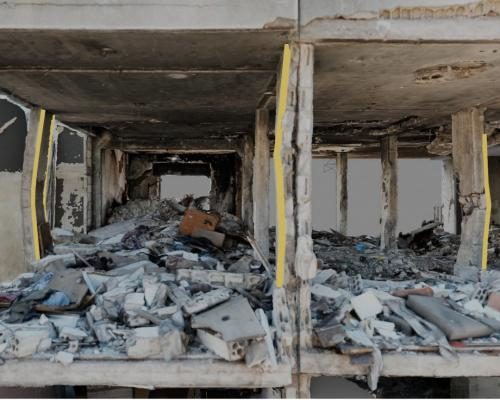
A Lebanese-French artist has taken a significant step towards justice by filing a legal complaint in a Paris court, alleging that an Israeli airstrike on his family home in Lebanon constitutes a war crime. The bombing, which occurred just hours before a ceasefire between Hezbollah and Israel on November 26, 2024, resulted in the deaths of the artist's parents and a domestic worker, raising serious questions about the legality of the attack.
Ali Cherri, the artist behind this complaint, has brought his case to the French war crimes unit, marking a rare instance of an individual pursuing legal action over an Israeli bombing. This lawsuit is notable not just for its personal implications for Cherri but also because it represents the first time a French court has entertained a case regarding Israel's military actions in Lebanon. Historically, Israel has faced numerous accusations of war crimes for targeting civilians, public infrastructure, and medical personnel, yet has largely evaded accountability for these actions. Originally reported by The Guardian.
Details of the Attack
On that fateful day in November, Cherri's family home, a structure built by his grandparents decades ago in central Beirut, was destroyed by an Israeli airstrike. The strike took place without any prior evacuation warning, damaging three floors of the apartment building. Tragically, Cherri's parents, Mahmoud Naib Cherri, 86, and Nadira Hayek, 76, along with their domestic worker, Birki Negesa, lost their lives in the attack, which also claimed the lives of four other civilians.
Reflecting on the loss, Cherri expressed deep sorrow. "We thought that they were out of danger," he said. "We never thought we were living somewhere where anything like this could happen." He recounted how his parents, despite not having completed school, worked tirelessly to provide him with a better life, instilling a sense of pride in their legacy.
International Response and Evidence
The case has drawn attention from human rights organizations. In February, Amnesty International published findings from an investigation into the bombing, asserting that there was no evidence of a military target at the time of the strike. The organization concluded that the attack warranted investigation as a potential war crime. Forensic Architecture, a UK-based investigative rights group, also contributed to the evidence, creating a 3D model of the Cherri family's apartment and identifying the munition used in the strike as a GBU-39, a 250-pound guided bomb produced in the United States and frequently deployed by Israel in both Gaza and Lebanon.
The meticulous analysis from Forensic Architecture underscored the targeted nature of the attack, placing responsibility squarely on the Israeli military. Amnesty International's regional director for the Middle East and North Africa, Heba Morayef, described the civil complaint in France as a "rare opportunity" to hold Israel accountable. "If war crimes unit prosecutors open an investigation into this complaint, this would offer a rare opportunity to examine Israel's actions in a European court given the general impunity it usually enjoys," Morayef stated.
Wider Implications Amid Renewed Conflict
Cherri views this legal action as crucial, especially amid escalating tensions between Israel and Lebanon, where similar attacks continue to occur. Following Hezbollah's rocket launches at Israel on March 2, 2025, Israeli forces retaliated with an aerial campaign and ground invasion that has already resulted in the deaths of 1,318 individuals. This renewed conflict serves as a painful reminder of Cherri's loss and the ongoing suffering in the region.
Tragedy struck again when Mohammed Shehab, a photographer involved with Forensic Architecture, was killed in a separate Israeli strike on March 11, 2025, which also claimed the life of his three-month-old daughter and left his wife critically injured. Forensic Architecture described the circumstances of Shehab's death as eerily similar to those surrounding the attack on Cherri's family home.
While Cherri acknowledges the slim chance of holding anyone in Israel criminally liable for the bombing, he remains steadfast in his belief that pursuing this case is necessary. "Either you accept that you're a victim and accept your fate, like unfortunately a lot of Lebanese have to do. Or you take it as a responsibility for all the other people who can't go through this legal process," he emphasized.
Originally reported by The Guardian. View original.