
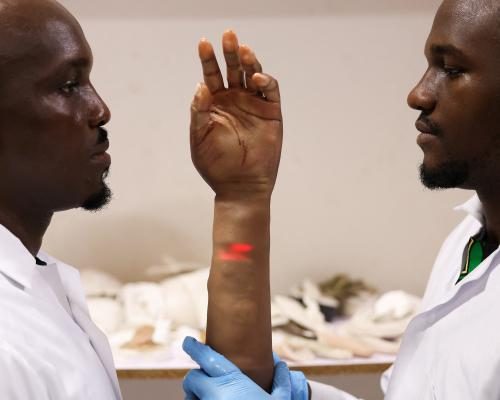
On a humid morning in Uyo, Nigeria, Ubokobong Amanam proudly demonstrates his new prosthetic hand, a remarkable creation that where his fingers once were. The lifelike appearance, complete with tiny wrinkles and naturally shaped nails, is a testament to the years of effort put in by him and his brother, John Amanam. Seven years ago, Ubokobong suffered a devastating injury in a firework accident that resulted in the loss of his fingers. While doctors managed to save his life, they could not save his hands. At that time, the available prosthetics were clunky, poorly fitted, and catered to body types that did not resemble his own. "At first, it was deeply disappointing to realise there were no hyper-realistic or even realistic African-style prosthetics," he shared. "That discovery made me feel worse and intensified my depression."
Determined to change this narrative, John Amanam, a special effects artist skilled in creating replicas of human bodies for film and theatre, joined forces with his brother. Together, they embarked on a mission to design a prosthetic that was tailored for Africans, by Africans. Realizing the staggering need-unofficial estimates suggest that up to 2 million people in Nigeria alone require prosthetic limbs-this initiative was not just personal but also a community-driven endeavor. Originally reported by The Guardian.
Accessibility Challenges in Prosthetic Technology
The statistics surrounding prosthetics in Africa are alarming. The high costs, often ranging from $2,000 to $3,000 (£1,500 to £2,250) for imported options, put them out of reach for many. Moreover, the majority of these prosthetics are designed for Western body types, rendering them unsuitable for most users in Africa. Ubokobong reflected on the shock of discovering that "prosthetics aren't really made for people like us." The mismatch extends beyond aesthetics; repairs necessitate importing spare parts, and high-quality products are scarce.
Globally, the situation is bleak. According to the Global Health Observatory's 2022 report, nine out of ten individuals who need assistive devices, including prosthetics, lack access to them. This crisis is particularly acute in low- and middle-income countries where the demand far exceeds supply. Dr. Natasha Layton, an occupational therapist and associate professor at Monash University in Australia, emphasizes that this issue isn't just about technology but also policy failures. "Assistive technology has often been treated as an optional extra rather than a core part of health services," she asserts. "But it is essential for access to education, employment, and social inclusion."
Innovating the Future: The Ubokobong Bionic Arm
After three years of intensive research and development, the Amanam brothers unveiled the Ubokobong Bionic Arm. Their company, Immortal Cosmetic Art, is now at the forefront of creating lifelike prosthetics tailored for amputees across the continent. Their mission is clear: to make advanced prosthetics more accessible to Nigerians and other Africans. Among their clients is 30-year-old Emediong Bassey, who lost her lower right leg in a motor accident in 2010. Bassey learned about John Amanam through Facebook and was thrilled to find a local solution for her needs. After a consultation and measurements, she received her prosthetic within weeks.
"It feels like my real leg," Bassey exclaimed. "It's comfortable and matches my skin tone. Most people don't even realise it's not my real leg because it so closely resembles my other leg in colour and shape." John Amanam meticulously incorporates details such as wrinkles, veins, fingernails, and fingerprints into each prosthetic using silicone molds of the user's body. The company is also exploring bionic prosthetics that employ electromyography technology to read muscle Signals, allowing users to control movement-an advancement in a field often dominated by costly foreign technology.
Aiming for Accessibility: Bridging the Gap
Despite the groundbreaking progress, the Amanam brothers face significant challenges. Each bionic limb costs around $7,000-lower than many Western alternatives but still unaffordable for most Africans. To address this gap, they are actively seeking support from governments and NGOs to make these technologies accessible. So far, they've provided free prosthetics to over ten clients, including Bassey, but the disparity between innovation and access remains stark. The global prosthetics market reflects a broader inequality; in the U.S., for instance, bionic limbs can cost tens of thousands of dollars without comprehensive insurance.
Opeoluwa Akinola, co-founder of the Accesstech Innovation and Research Centre, highlights the promise of local manufacturing for prosthetic limbs. Customization for local climates, work environments, and lifestyles can significantly improve durability and functionality. Prosthetics produced in Europe may not withstand the rigors of physical labor common in African communities, and the cost of repairs can be prohibitive.
As the Amanam brothers continue to innovate in the prosthetic space, their journey exemplifies the potential for local solutions to address pressing healthcare needs. Their work not only offers hope to individuals like Ubokobong and Emediong but also serves as a critical step toward improving access to essential assistive technologies across the continent.
Originally reported by The Guardian. View original.