
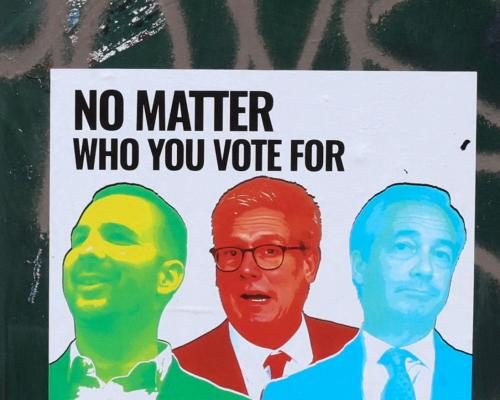
In a quirky twist on political engagement, a new viral game called "Guess the Party" has taken social media by storm, prompting players to identify the political party affiliations of local election candidates solely based on their photographs. Created by Sam Hamill-Stewart, the game highlights the often misleading nature of appearances in politics, demonstrating that assumptions based on looks can be very deceptive.
Guessing Game Takes Westminster by Storm
Launched amid the local elections, the game quickly gained traction, racking up over 3.9 million guesses from approximately 134,000 players by the close of polling on Thursday night. Participants were challenged to guess party affiliations from images of candidates, which were sourced from Democracy Club. Hamill-Stewart, before releasing the game, ensured that any images featuring party logos were removed to maintain the challenge. Originally reported by The Guardian.
While players relied on stereotypes-such as a bristly grey moustache for Reform candidates or sharp suits for Tories-the reality proved far more complex. For example, a red tie, often associated with Labour, turned out to be a red herring for many candidates. This complexity kept players engaged and often perplexed.
Identifying Candidates: The Statistics Tell a Story
According to the game's statistics, players found it easiest to correctly identify Green party candidates, with a success rate of 37.5%. Reform candidates followed closely behind at 35.4%. However, the Liberal Democrats emerged as the most challenging party to identify, with only 15.2% of players guessing correctly. These figures illustrate not only the difficulties in associating appearance with political affiliation but also highlight the nuances in modern political branding.
Some candidates garnered particularly high recognition rates. For instance, Jacky Carr, a freelance theatre producer and artist running in Broxbourne, was correctly identified as a Green candidate by a staggering 91.3% of players. Similarly, Alan John Outlaw, standing in Keighley East, was recognized as a Reform candidate by 80.7%. Yet, these successes were exceptions in a game filled with surprises.
Breaking Stereotypes: Candidates Who Confounded Players
Despite the game's playful premise, the results also revealed a troubling trend in assumptions based on appearances. Martin Radbon, the Green party candidate for Erith, was misidentified by 98.3% of players, with most believing he was affiliated with Reform. Laura Caroline Harrison, standing for the Conservatives, faced similar confusion; only 2.5% of players recognized her as a Tory, as many were misled by her striking purple hair, which seemed more in line with Green party branding.
Of the five candidates most commonly misidentified as Greens, four sported colorful hairstyles-pink, red, or purple-but were actually running for the Conservatives, Labour, or the Liberal Democrats. This pattern suggests a disconnect between visual cues and party identity, raising questions about how voters perceive candidates in a landscape where visual presentation plays an increasingly significant role.
The Cultural Impact of Political Stereotyping
This viral game not only entertains but also serves as a cultural commentary on the politics of appearance. It challenges players to confront their biases and assumptions about political candidates, pushing them to consider the complexity behind each individual. As the political landscape evolves, understanding these dynamics becomes crucial for voters striving to make informed choices.
In engaging with "Guess the Party," players are encouraged to think critically about how they perceive political figures, recognizing that appearances can be misleading. This timely game reflects a growing awareness of the need for voters to look beyond superficial traits and consider candidates' policies and qualifications more deeply.
As the game continues to spread across social media platforms, it raises important discussions about identity, representation, and the role of visual cues in politics. How voters adapt to these insights may shape the future of electoral engagement in an increasingly polarized environment.
Originally reported by The Guardian. View original.