
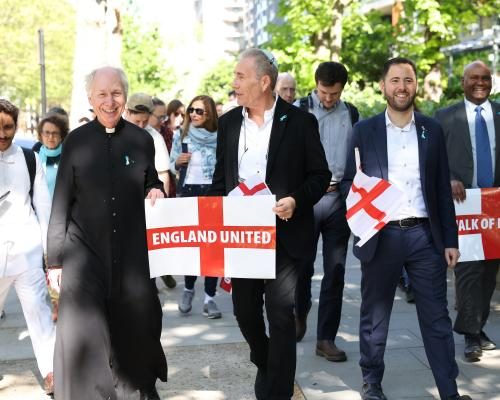
In a bid to combat rising hatred and promote unity, an interfaith event celebrating St George's Day took place in Regent's Park, London, drawing around 50 participants, including faith leaders and community members. As antisemitism and anti-Muslim sentiment soar in the UK, the need for interfaith dialogue has never been more critical.
Unity Amid Rising Hatred
Maurice Ostro, founder patron of the Faiths Forum for London, has dedicated decades to interfaith initiatives. He recalls a time when such efforts were met with skepticism, as many believed they were unnecessary in the UK. "People used to laugh at me for doing this work," Ostro reflected. However, the current climate of record-breaking antisemitism and anti-Muslim hatred has made the importance of these gatherings undeniable. Originally reported by The Guardian.
The interfaith walk, which commenced at St John's Wood church on a sunny Thursday afternoon, featured participants waving St George's flags and displaying placards that read "Faiths United" and "England United." Rev Anders Bergquist welcomed attendees, emphasizing that St George's Day should serve as a symbol of unity rather than division.
A Route Through Diversity
Participants began their walk from the church to a nearby synagogue, and ultimately ended their journey at London Central Mosque. Each stop highlighted the rich tapestry of religious diversity in the city. At the mosque, Imam Sheikh Khalefa Ezzat delivered a powerful message about the "value of unity, peace, and courage." He stated, "Our duty is to bring peace and bring people together.. not to divide them."
Ostro noted that interfaith work goes beyond casual gatherings; it's rooted in personal history. As the child of a Holocaust survivor, Ostro has seen the devastating effects of hatred firsthand. "Most of my family was wiped out because of this needless hatred," he shared, underscoring that his life, and the lives of his descendants, are a testament to the power of solidarity during dark times.
Celebrating St George's Day Together
St George's Day, traditionally a celebration of English heritage, has become a focal point for promoting inclusivity. Julie Siddiqi, founder of Together We Thrive and co-chair of the British Muslim Network, emphasized that the day should not be a source of division. "We should be celebrating and coming around the flag, and not shying away from that," she asserted.
Sunder Katwala, director of British Future, highlighted research indicating a broad consensus on what it means to be English, suggesting that identity is not solely defined by ethnicity. He pointed out that events like the interfaith walk help alleviate anxiety among minority communities about their belonging. "When people see that, they feel reassured," he explained, referencing a long-standing St George's Day parade in Dartford that promotes cohesion among diverse groups.
Counteracting Online Hate
While rising hate crimes are a pressing concern, Phil Rosenberg, director of the Board of Deputies of British Jews, cautioned against allowing distorted views of society to prevail. He attributed this issue in part to social media, where algorithms often prioritize extreme rhetoric. "We're seeing real people in all their complexity," Rosenberg noted, emphasizing the importance of engaging with communities offline to counteract online divisiveness.
As the interfaith walk drew to a close, Ostro reflected on the significance of such gatherings in today's society. "It's easy to feel victimized or backed into a corner," Siddiqi said, urging more minority communities to participate and embrace their identities. "I refuse to fall into a victim mentality."
Ultimately, events like this not only strengthen communal ties but also serve as a vital reminder that unity can triumph over hatred. As communities across the UK come together to celebrate St George's Day, the hope is that these interactions will foster a sense of belonging and peace that transcends religious and cultural boundaries.
Originally reported by The Guardian. View original.