
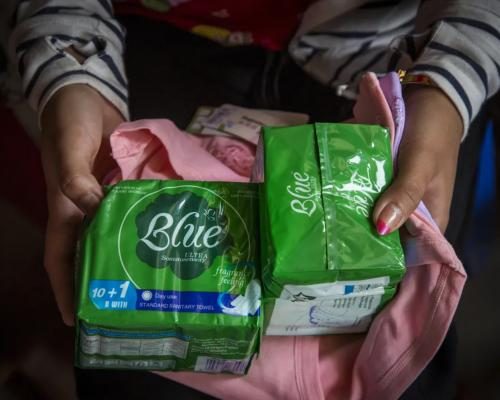
The military regime in Myanmar has intensified its ban on the distribution of sanitary towels, asserting that rebels are utilizing these essential products for medical treatment, according to local Activists. Since the military seized power from the democratically elected government in February 2021, the nation has been embroiled in a civil war that has seen widespread violence and human rights violations.
Artillery strikes, the burning of villages, and arbitrary detentions have become commonplace as the military seeks to quash dissent. Thinzar Shunlei Yi, a director at Sisters2Sisters, a women's rights organization supporting resistance fighters, stated, "The [military is] saying menstrual products are used by the People's Defence Force for medical reasons and as support for their feet and boots to absorb sweat and blood." Despite these claims, no official communication from the military government has been issued regarding the rationale behind the ban. Originally reported by The Guardian.
Origin and Expansion of the Ban
The ban on sanitary products began in August 2023, targeting specific regions where opposition forces exert control. Transportation of menstrual pads across the bridge connecting Sagaing and Mandalay, the country's second-largest city, has been completely prohibited. Thinzar Shunlei Yi emphasized that the ban has expanded this year and is likely more widespread than initially believed, largely due to societal taboos surrounding discussions about menstruation.
Meredith Bunn, founder of the medical aid organization Skills for Humanity (SFH), criticized the military's claims, asserting that anyone familiar with combat medicine would know that sanitary towels are not suitable for treating gunshot wounds or lacerations. "A sanitary pad wouldn't stay in place, wouldn't soak enough blood and wouldn't keep the area [clean]," she noted. This perspective highlights the ignorance and misogyny she perceives within the military hierarchy.
The Impact on Women's Health and Rights
The ban has forced many women to resort to unsafe alternatives such as rags, leaves, or newspaper, which can lead to serious health issues. Henriette Ceyrac, founder of Pan Ka Lay, an organization focused on menstrual education in Myanmar before its closure, explained, "It can cause urinary tract infections [UTIs], reproductive tract infections; just a lot of discomfort and pain." For many, the only option left is the hidden market, where the price of sanitary products has skyrocketed from 3,000 kyat (approximately £1) to 9,000 kyat. Considering that the minimum daily wage in Myanmar is only 7,800 kyat, this price surge presents a significant barrier.
Health care in Myanmar is already in a state of collapse, making access to medical assistance extremely limited. Thinzar Shunlei Yi reported that Sisters2Sisters often receives requests for antibiotics to treat UTIs, a common consequence of inadequate menstrual hygiene. The psychological impact is also profound, with women feeling distressed and uncomfortable, sometimes opting to remain indoors during their periods to avoid participating in political activities.
Gender-Based Violence and Military Tactics
There is a growing belief that the military's actions are a deliberate strategy to further restrict women's mobility and autonomy. Henriette Ceyrac remarked, "It makes sense actually that [the military] wants to restrict women's movement even more. It's basically gender-based violence." This tactic, according to Meredith Bunn, aims to target female fighters, control civilian populations, and victimise those in displacement camps. More than 3.5 million individuals have been displaced since the onset of the civil war.
While organizations on the ground are attempting to distribute reusable pads, the lack of access to clean washing facilities exacerbates the health risks associated with menstruation. "A lack of menstrual equipment and areas to wash them properly can cause infections, irritation, UTIs and worse," Bunn explained. Additionally, alternative menstrual products like cups and tampons remain scarce in Myanmar, with societal norms discouraging women from seeking information about them.
Thinzar Shunlei Yi stated that local advocacy groups have alerted the United Nations about the dire situation, labeling the ban on such a fundamental necessity as a human rights violation. As the military regime continues to impose restrictions, the plight of women in Myanmar highlights the intersection of health, rights, and the ongoing struggle for freedom amid a brutal civil conflict.
Originally reported by The Guardian. View original.