
In a dramatic escalation of regional tensions, missile attacks have targeted the US embassy in Baghdad, coinciding with a significant delay in former President Donald Trump's upcoming summit with Chinese President Xi Jinping. This latest wave of violence is part of Iran's retaliatory campaign amid heightened conflict in the Middle East.
The Iraqi capital witnessed intense assaults early Tuesday morning, involving at least five drones aimed at the US embassy, marking the most concentrated attack since the hostilities began. Witnesses reported hearing a powerful explosion, and Iraqi air defenses managed to intercept several rocket attacks aimed at the embassy. Security officials confirmed that air defenses thwarted an attack involving four rockets, with additional reports of a drone causing a fire at the luxury al-Rasheed Hotel, located in Baghdad's heavily fortified Green Zone, which hosts diplomatic missions. Originally reported by The Guardian.
Qatar Intercepts Missile Attack Amid Regional Turmoil
In a related incident, Qatar's defense forces successfully intercepted a missile attack, although debris from the interception resulted in a minor fire in an industrial area. Fortunately, there were no reported injuries. This interception reflects the increasing threats faced by Gulf nations, as Iranian drones and missiles have targeted multiple states in the region recently. The Iranian retaliation comes in response to ongoing US-Israeli military actions against Iranian interests.
Qatar's Ministry of Interior confirmed the incident via social media, indicating that civil defense teams were addressing the fire caused by the falling debris. This development highlights the precarious security situation in the region as tensions continue to rise amid ongoing military engagements.
Rocket Strikes and Casualties in Iraq
Shortly after the hotel incident, a loud blast echoed through Baghdad as air defenses intercepted an attack over the US embassy. The Iraqi Prime Minister, Mohammed Shia al-Sudani, condemned the attacks, which included a strike on a southern oil field, labeling them threats to Iraq's security and stability. This round of violence has further plunged Iraq into the broader Middle East conflict, already a battleground for US-Iranian proxy engagements.
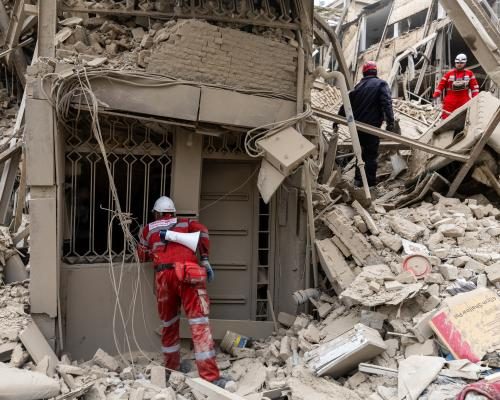
Reports indicate that a separate strike on a residential house in Baghdad resulted in the deaths of four individuals, with initial reports suggesting two of the deceased were Iranian advisors linked to Tehran-backed groups. This incident demonstrates the intertwining of local and regional conflicts, as the ongoing war in the Middle East draws Iraq deeper into the fray.
Trump Delays China Summit Amid Ongoing Conflict
Amid this escalating violence, former President Donald Trump announced that his planned trip to China for discussions with President Xi Jinping could face a delay of "a month or so." Trump articulated that the ongoing war necessitated his presence in the United States, stating, "I would love to, but because of the war, I want to be here." He indicated that the delay was not intended to pressure Beijing into assisting with issues concerning the Strait of Hormuz, a critical chokepoint for global oil shipments.
Trump's treasury secretary, Scott Bessent, echoed this sentiment, clarifying that the potential postponement of the summit should not be misconstrued as a tactic to compel China to act regarding the strait. Bessent emphasized that the discussions' timing would depend on the evolving situation in the Middle East.
UAE Responds to Iranian Threats
Meanwhile, the United Arab Emirates is actively responding to incoming missile and drone attacks from Iran. The UAE's Ministry of Defense reported that its air defenses were engaged in intercepting various aerial threats, indicating a significant increase in hostilities emanating from Iranian territory. Social media updates from the ministry confirmed that the sounds reported in the Emirates were indeed the result of aerial defenses neutralizing incoming projectiles.
Following these incidents, air traffic operations in the UAE returned to normal after a temporary closure of its airspace due to the ongoing threats. This swift resumption of operations underscores the urgency with which the UAE is addressing the security risks posed by the current conflict.
The situation in the Middle East remains fluid and unpredictable, with military engagements and diplomatic efforts colliding against a backdrop of escalating violence. As nations grapple with the ramifications of these attacks, the international community watches closely, hoping for a de-escalation in hostilities.
Originally reported by The Guardian. View original.