
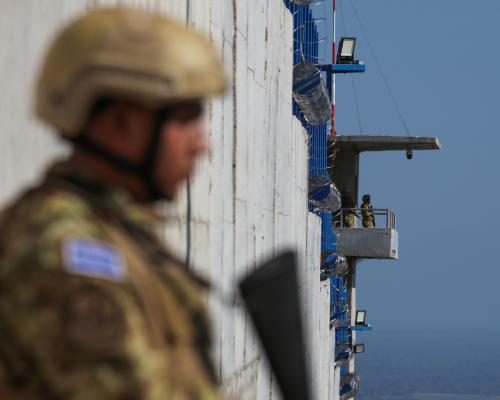
El Salvador's aggressive mass incarceration strategy, spearheaded by President Nayib Bukele, has raised grave concerns about potential crimes against humanity, according to a recent report by legal experts. The study reveals that the government's approach, which has seen 1.4% of the population jailed without due process, has transformed El Salvador from one of Latin America's most violent nations to one of its least violent, albeit at a significant cost to human rights and the rule of law.
Compiled by an international assembly of experts from the Due Process of Law Foundation, the report details alarming incidents of arbitrary imprisonment, torture, murder, and forced disappearances that have occurred under the state of exception declared by Bukele four years ago. The findings suggest that these actions stem from a policy actively promoted by the highest levels of government, raising serious ethical and legal questions. Originally reported by The Guardian.
Systematic Attacks on Civilians
The report outlines how the systematic nature of these attacks on the civilian population provides reasonable grounds to believe that crimes against humanity are being committed in El Salvador. Santiago Canton, co-author of the report and general secretary of the International Commission of Jurists, emphasized the need for the international community to respond: "The state must protect citizens from organised crime - but with the law, and with respect for human rights."
Since the imposition of a state of exception in March 2022, Bukele has suspended constitutional rights to combat the notorious gangs MS-13 and Barrio 18, which have long plagued Salvadoran society. Approximately 90,000 individuals have been detained under this policy, with many held in pre-trial detention under dire conditions. Human rights organizations estimate that thousands of those arrested lack any association with gang activity, highlighting the indiscriminate nature of the arrests.
Grim Conditions and Human Rights Violations
Conditions in detention facilities are reportedly grim, leading to over 400 documented deaths in custody. Many of these detainees are held in the Terrorism Confinement Centre (Cecot), a massive prison constructed specifically for gang members. The facility has also been used by the Trump administration to detain over 252 Venezuelan migrants, many of whom recounted experiences of abuse and torture before being expelled back to Venezuela as part of a controversial prisoner swap.
While Bukele's crackdown has successfully dismantled the territorial control of gangs, resulting in a significant drop in homicide rates, it has simultaneously stripped away the rights and freedoms of countless citizens. This juxtaposition has created a complex narrative where many Salvadorans feel a sense of safety for the first time in years, yet at an enormous human cost.
Bukele's Growing Popularity and Authoritarian Trends
Despite the troubling implications of his mass arrest policy, Bukele remains a popular figure, having secured an unconstitutional second consecutive term in 2024. His approach, often referred to as the "Bukele model," has garnered admiration from various leaders across Latin America and beyond. For instance, Chile's incoming president, José Antonio Kast, described El Salvador as "a lighthouse in a world roiled by organised crime."
However, this popularity comes at the expense of democratic norms. Bukele has systematically dismantled checks and balances, dismissing judges who oppose him, altering the electoral framework to benefit his party, and targeting dissenters in civil society and the media. Many critics have fled the country, with organizations like Cristosal, a prominent human rights group, relocating to Guatemala after facing severe repression.
Consequences for Central American Democracy
As El Salvador's Congress, dominated by Bukele's party, eliminates presidential term limits, the implications for democracy in the region are dire. "It took us decades to build democracy in all these countries," Canton lamented. "And the Bukele model that these Latin American politicians are lauding ultimately implies its destruction."
The legal experts' report urges the United Nations to initiate an international investigation into the situation, highlighting the need for accountability and the restoration of human rights in El Salvador. As the country grapples with its violent past and uncertain future, the balance between security and civil liberties remains precariously tilted.
Originally reported by The Guardian. View original.