
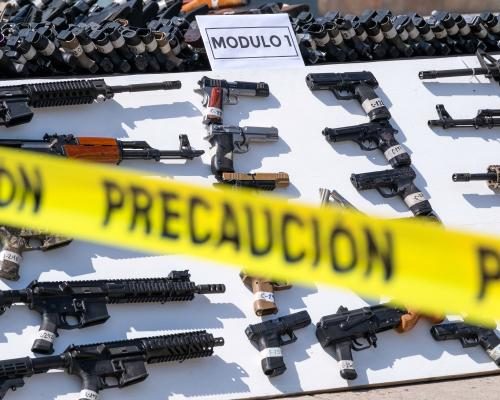
In a robust response to former President Donald Trump's recent remarks branding Mexico as the "epicenter of violence," Mexican President Claudia Sheinbaum highlighted the critical role of U.S. gun trafficking in exacerbating the country's security crisis. Speaking at a press conference, Sheinbaum emphasized that 75% of firearms used by Mexican cartels originate from the United States, urging American lawmakers to take decisive action against the illegal flow of weapons into Mexico.
Sheinbaum's Call to Action
During her address, Sheinbaum stated, "There is something that the U.S. can help us a lot with: stop the trafficking of illegal weapons from the U.S. to Mexico." She pointed out that curtailing the entry of these weapons would significantly hinder the operational capabilities of criminal organizations in the country. This appeal comes in the wake of Trump's comments made during a gathering of Latin American leaders at his Miami-area golf club, where he asserted that the violence orchestrated by Mexican cartels poses a direct threat to U.S. national security. Originally reported by The Guardian.
Trump's speech at the Shield of Americas summit featured stark language, with the former president claiming, "The epicenter of cartel violence is Mexico," and accusing the cartels of fueling chaos across the hemisphere. Sheinbaum's remarks suggest a growing frustration in Mexico regarding the perception that the country bears sole responsibility for cartel-related violence, highlighting the systemic issues tied to U.S. gun laws and demand for narcotics.
Legal Battles Over Gun Trafficking
Mexico has long sought to address the issue of gun trafficking, taking legal measures against American gun manufacturers. In 2021, the Mexican government filed a lawsuit against several U.S. gunmakers, accusing them of "negligent marketing, distribution, and sales" that contribute to the trafficking problem. However, this lawsuit was dismissed by the U.S. Supreme Court last year, limiting Mexico's ability to hold these companies accountable legally.
Despite the legal setback, Sheinbaum reiterated the need for collaboration between the two nations to tackle the root causes of gun violence. She underscored that without intervention from the U.S. to restrict arms trafficking, Mexican authorities would struggle to contain the rampant violence that has plagued the nation for years.
Trump's Comments and Their Implications
Trump's comments, particularly his characterization of Sheinbaum as a "beautiful woman" with a "beautiful voice," have drawn criticism for being sexist and undermining the serious nature of the discussion. Viri Ríos, a Mexican political analyst, reacted strongly, stating, "The epicenter of cartel violence is not Mexico, it's the United States." She emphasized that U.S. demand for drugs and the supply of weapons are fundamentally intertwined, fueling the ongoing conflict.
In her response to Trump's assertion that he could send U.S. military forces into Mexico to combat drug trafficking, Sheinbaum firmly rejected the idea, stating, "It's good that President Trump publicly says that when he has proposed that the United States military enter Mexico, we have said no. Because it's the truth." This response highlights a significant diplomatic tension between the two nations, particularly regarding sovereignty and the approach to handling drug-related violence.
Understanding the Broader Context
Sheinbaum's insistence on addressing gun trafficking reflects a broader concern among Mexican officials about the impact of U.S. policies on domestic security. As violence continues to rise, the Relationship between the two nations is increasingly strained, with each side accusing the other of failing to address the underlying issues contributing to cartel violence.
While Trump's rhetoric may resonate with certain segments of the U.S. population, it underscores a complex reality: the intertwined fates of Mexico and the U.S. when it comes to drug trafficking and violence. As Sheinbaum navigates these diplomatic waters, her administration faces the dual challenge of managing public safety at home while advocating for meaningful changes in U.S. policy regarding gun trafficking.
Looking ahead, the ongoing dialogue between the two nations will be crucial in shaping the future of their relationship and the fight against organized crime. Both leaders must confront the reality that sustainable solutions require cooperation and a shared commitment to tackling the root causes of violence, rather than placing blame solely on one side of the border.
Originally reported by The Guardian. View original.