
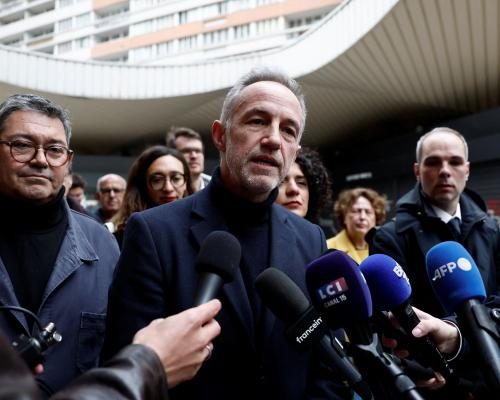
As the final round of local elections approaches this Sunday, political parties in France are racing to form strategic alliances. Following a strong performance by both the far right and the radical left in the first round, the upcoming votes for mayors and local councils in key cities like Marseille, Lyon, and Paris promise to be highly competitive. These municipal elections are a vital test of political strategies and coalition-building ahead of the presidential elections scheduled for next year, as President Emmanuel Macron's two terms conclude in spring 2027.
Key Political Contenders in Paris
In Paris, the Socialist candidate Emmanuel Grégoire emerged as the frontrunner in the first round, surpassing former culture minister Rachida Dati, who is determined to reclaim the city for the right after 25 years of leftist governance. Despite their bitter exchanges during the campaign-Bournazel labeled Dati as "inebriated with narcissism" while she dismissed him as the "physical incarnation of the stupidest right in the world"-Dati is now seeking a potential alliance with centrist candidate Pierre-Yves Bournazel to enhance her chances. Originally reported by The Guardian.
However, Grégoire raised concerns about Dati's upcoming trial in September, where she faces allegations of corruption and abuse of power linked to her lobbying activities for the Renault-Nissan group during her time in the European Parliament. He warned that Dati embodies the troubling trend of the "Trumpisation" of political life, asserting that any alliance with Bournazel is illogical. Dati maintains her innocence and has denied all wrongdoing.
Far-Right Gains in Paris
In a significant shift, Sarah Knafo, a member of the far-right anti-immigration Reconquest party, made notable headway in affluent areas of western Paris, securing 10% of the vote-marking the party's first substantial presence in local elections in the capital. Knafo is linked to Éric Zemmour, the founder of Reconquest, known for his controversial history of inciting racial hatred. Meanwhile, Sophia Chikirou, a candidate representing Jean-Luc Mélenchon's radical left party, La France Insoumise (LFI), also advanced to the second round. Chikirou expressed her willingness to collaborate with Grégoire to counter the right but faced rejection from him, who aims to unite leftist parties, including Socialists and Greens, without involving the LFI.
Despite a previously weak local presence, Mélenchon's party fielded more candidates this time, suggesting a potential increase in local council seats. Bally Bagayoko clinched the mayoral position for LFI in Saint-Denis, outpacing Socialist candidate Mathieu Hanotin, who had been a prominent figure in local politics during the 2024 Olympics.
Strategic Alliances in Other Cities
In Toulouse, after exceeding expectations in the first round, the LFI candidate formed an alliance with the Socialist representative to challenge incumbent right-wing mayor Jean-Luc Moudenc, who criticized the coalition as the "alliance of shame." Similar partnerships have emerged in Avignon, where LFI and Socialist candidates united to strengthen their electoral chances.
Raphaël Glucksmann, a centre-left figure and potential presidential candidate for 2027, criticized any collaboration between centre-left and LFI factions, noting that while Mélenchon's party performed well in certain cities, the broader centre-left had significantly outpaced them across France.
The Race for Marseille
In Marseille, the National Rally (RN), led by Marine Le Pen, witnessed a strong showing from its candidate Franck Allisio, who trailed the incumbent Benoît Payan of the Printemps Marseillais coalition, comprising Socialists and Greens. Should the RN secure control of Marseille, it would signify a major breakthrough in a city where they have historically struggled. As the final round approaches, Payan has ruled out any alliances with the LFI candidate, emphasizing the need for clarity and unity on the left to prevent RN from gaining power.
In the first round, the RN successfully elected 24 mayors, and some final-round contests, such as in Toulon, may see other parties coalesce to inhibit the RN's momentum. Additionally, in Nice, Éric Ciotti, an ally of the RN, is positioned well for the final round, leveraging his extensive experience in the region, even though he did not run under the RN banner.
As the electoral landscape continues to evolve, the outcomes of these run-offs could reshape the political dynamics in France, paving the way for the critical presidential election next year.
Originally reported by The Guardian. View original.