
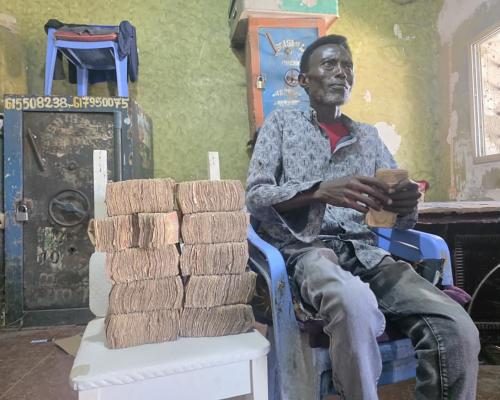
In Somalia, the economic landscape has dramatically shifted as the Somali shilling becomes increasingly worthless, leaving many of the country's poorest citizens struggling to survive. Muse Omar Jama, a 49-year-old exchange trader in Mogadishu, recalls a time when his work allowed him to meet basic needs. Now, he laments, "It's like we went bankrupt overnight." Following a grassroots movement last month that saw traders reject the aged and deteriorating banknotes, the economic consequences have been swift and severe.
Currency Collapse Triggers Economic Chaos
As the Somali shilling faces an existential crisis, a coalition of traders in Mogadishu initiated a widespread rejection of the currency. This movement began in early May when traders, frustrated with the condition of the banknotes, decided to stop accepting them. The decision quickly gained traction, affecting businesses, shops, and public transport, leading to a sharp rise in prices for everyday goods. For instance, the cost of a small bag of powdered milk has more than doubled. Originally reported by The Guardian.
With the country grappling with ongoing drought and soaring global food prices, the poorest citizens are feeling the brunt of this economic upheaval. The situation has intensified the reliance on US dollars, as Somalia has not printed any new banknotes since 1991, following the collapse of the central government. Muse Omar Jama notes, "Prior to the rejection of the Somali shilling, I was able to make enough to cover the basics such as rent, electricity, and water." Now, he finds himself walking several miles to work, unable to afford bus fare.
Impact on Daily Life and Local Businesses
The ramifications of the shilling's rejection extend beyond traders like Jama. Asha Ali Ahmed, 39, who operates a vegetable stall in Mogadishu, shares her plight. "We were raised off the earnings from this vegetable stand," she recalls. Farmers are now refusing to accept shillings, insisting on mobile money payments instead. This shift has driven up vegetable prices further, compounding the challenges posed by the ongoing drought.
According to the World Food Programme, approximately 6.5 million people-nearly a third of Somalia's population-are facing severe hunger, and 2 million children under five years old are suffering from acute malnutrition. Ahmed reflects on how this crisis is affecting her customers, many of whom can only afford to buy in shillings. "Paying with mobile money means they have to pay more, and most can't afford to," she adds.
The Role of Remittances in a Dollarized Economy
Somalia's heavy reliance on remittances has further complicated the situation. The diaspora sends billions of dollars annually back home, primarily in US currency. These transfers play a crucial role in the economy, flowing through informal money-transfer systems known as hawala. The presence of international organizations, including the UN and various aid agencies, has reinforced the dollar's dominance in daily transactions.
The Somali shilling, once the only recognized currency, has become increasingly irrelevant, particularly in regions outside Mogadishu. The breakaway territory of Somaliland has issued its own currency, exacerbating the fragmentation of the monetary system. As a result, the only areas still accepting shillings are limited to certain towns and districts in the south.
Protests and Despair in Mogadishu
The discontent among traders culminated in a protest on May 4, where many exchanged their old banknotes while declaring, "Somalia is the only country without a currency." Muse Omar Jama, however, chose not to join the demonstration, feeling disillusioned by the bleak outlook. "Our currency is dead, and so is our way of life," he states, echoing a sentiment shared by many across the nation.
As the Somali shilling continues to lose value, the daily struggles of the population become more pronounced. People from all walks of life, including beggars who relied on small shilling donations, are now left with worthless notes. Jama describes how he must turn away those seeking to exchange their shillings for mobile money, as his safes are overflowing with unexchangeable currency. The rejection of the Somali shilling has created a chasm in the economy, one that could take years to bridge.
The future remains uncertain for both traders and consumers in Somalia. As the nation grapples with a currency crisis, the resilience of its people will be tested, with many hoping for a return to stability and a viable currency system.
Originally reported by The Guardian. View original.