
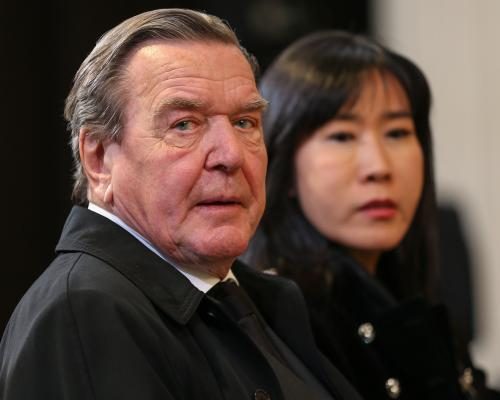
In a surprising move, Russian President Vladimir Putin suggested that former German Chancellor Gerhard Schröder could serve as a mediator in the ongoing Ukraine conflict. This proposal has elicited a cautious response from German officials, who expressed skepticism about its sincerity. They see it as part of a broader pattern of insincere overtures from Moscow, according to multiple government sources.
Putin's comments came during a recent address where he claimed the war in Ukraine is winding down, suggesting that Schröder, who has maintained a close relationship with the Kremlin since his tenure ended, could play a pivotal role in negotiating peace. Schröder, 82, has been a controversial figure in the West due to his past involvement in Russian energy projects, including key roles in the Nord Stream gas pipelines and a position on the board of the Russian oil giant Rosneft, which he resigned from last year. Originally reported by The Guardian.
Germany's Cautious Stance on Schröder
German officials have reacted with reserve to Putin's proposal. They acknowledged his remarks but categorized them as part of a series of hollow offers from Russia. One source pointed out that a genuine test of Moscow's intentions would involve extending the current three-day truce, which was established amid ongoing hostilities. This skepticism reflects a broader concern that Russia may be attempting to manipulate the situation rather than genuinely seeking resolution.
Michael Roth, a former lawmaker from Germany's Social Democratic Party (SPD) and current chair of the foreign affairs committee, emphasized that any mediator must have the acceptance of Ukraine. "A mediator cannot be Putin's buddy," he stated in an interview with the Tagesspiegel, reinforcing the idea that Ukraine should ultimately decide who represents their interests. This highlights a fundamental issue: the importance of Ukrainian agency in any peace negotiations.
Mixed Reactions from the SPD
Within the SPD, the reactions have been divided. While some members have echoed Roth's concerns, others are more open to considering Putin's suggestion. Adis Ahmetovic, the party's foreign affairs spokesperson, indicated that the proposal warrants careful contemplation in conjunction with European partners. Ralf Stegner, another SPD lawmaker, argued that Europe should seize every opportunity to influence Ukraine's future, emphasizing that the decision shouldn't be left solely to Putin and former U.S. President Donald Trump.
This internal debate within the SPD reflects the complexities of international diplomacy, especially in a situation as fraught as the Ukraine conflict. The idea of involving someone like Schröder, who has been criticized for his ties to Russia, raises questions about credibility and the potential for genuine mediation.
Ceasefire Tensions and Continued Conflict
Despite talks of a truce, the ceasefire, which was mediated by the United States, appears to be under significant strain. On the second day of the agreement, both Ukraine and Russia accused each other of violating the terms, with reports of ongoing attacks and skirmishes. Ukrainian officials reported that three people were killed in drone strikes near the frontline, and over 200 battlefield clashes had occurred since the truce began. In response, Russia's defense ministry claimed to have intercepted 57 Ukrainian drones in a single day, accusing Ukraine of not adhering to the ceasefire.
The ongoing violence complicates the already delicate situation and raises questions about the feasibility of any proposed negotiations. As tensions escalate, both sides seem entrenched, making the prospect of meaningful dialogue increasingly elusive. The involvement of U.S. envoys, including Steve Witkoff and Jared Kushner, in upcoming discussions with Russia indicates that external powers remain invested in finding a resolution, but the path forward remains fraught with challenges.
Regional Implications and Shifting Alliances
In a related development, diplomatic relations between Russia and Armenia have cooled, further complicating the regional dynamics. Russia has accused Armenia of facilitating anti-Russian sentiments, particularly following remarks made by Ukrainian President Volodymyr Zelenskyy during a recent visit to Yerevan. Zelenskyy's comments suggested that Russia fears its military capabilities may be undermined, symbolized by the potential for drones to reach Moscow.
This deterioration in relations highlights the shifting alliances in the region as countries navigate their positions amid the conflict. Additionally, the resignation of Latvia's defense minister, Adris Spruds, following a drone incursion from Ukraine that damaged oil storage facilities, underscores the increasing tensions among neighboring states and the repercussions of the conflict spilling beyond Ukraine's borders.
As the situation evolves, the international community watches closely, hoping for a breakthrough that could lead to lasting peace in Ukraine. However, with skepticism surrounding proposals like Schröder's potential mediation and ongoing violence, the path to resolution remains uncertain.
Originally reported by The Guardian. View original.