
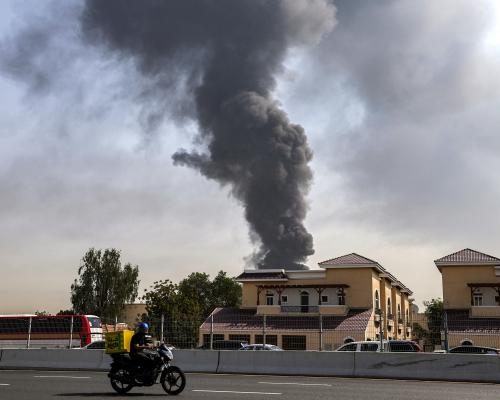
The booming echoes of missile interceptions have become an unsettling backdrop in the Gulf, particularly in Dubai, where high-rise windows tremble under the force of defensive measures against Iranian attacks. As the conflict between the U.S., Israel, and Iran escalates, Gulf Cooperation Council (GCC) countries are grappling with an existential threat that they are desperate to avoid entangling themselves in.
Just moments before the latest explosive reverberation, a warning echoed through the air as mobile phones sounded alarms, signaling potential missile or drone strikes-a new norm for residents and visitors alike in the region. Amidst the chaos, patrons at a coffee shop barely flinched, a testament to the grim reality of life in the Gulf. The United Arab Emirates' air defense systems are currently on high alert, successfully intercepting a significant number of incoming threats, including ballistic missiles and drones. Originally reported by The Guardian.
Escalating Military Engagements
Since the onset of hostilities initiated by the U.S. and Israel against Iran, the Gulf states have endured a relentless barrage of Iranian missile and drone strikes targeting critical infrastructure, including airports, hotels, and military bases. The attacks have shattered the illusion of safety that cities like Dubai once enjoyed, raising alarms over national security and economic stability in the region.
The GCC, a political alliance consisting of Saudi Arabia, Qatar, the UAE, Kuwait, Bahrain, and Oman, has so far maintained a defensive stance. They have invested heavily in advanced interception technology, managing to neutralize approximately 90% of Iranian munitions. However, the ongoing assaults have ignited fears of a broader conflict, with calls for Gulf nations to consider a more aggressive response growing louder.
Iran's Strategic Retaliations
Following a notable Israeli strike on Iran's South Pars gas field, which marked a significant escalation in the conflict, Iranian officials have promised to retaliate without restraint. This vow has manifested in a series of destructive strikes against energy infrastructure throughout the Gulf, raising stakes dramatically. For instance, Qatar's Ras Laffan gas complex experienced damages that compromised nearly 20% of its liquefied natural gas export capacity, while operations at the UAE's Habshan gas facility were halted due to attacks.
Additionally, Kuwait's Mina al-Ahmadi refinery has suffered multiple drone strikes, and Saudi Arabia reported that two of its oil refineries were targeted as well. These attacks underscore the vulnerability of the region's energy resources, which are crucial not only for the Gulf nations but also for global energy supplies. With Iran maintaining its blockade of the Strait of Hormuz, a critical maritime route for oil transport, the GCC faces tough decisions about how to respond effectively.
The GCC's Dilemma: To Retaliate or Not?
The situation has exposed deep-seated anxieties within the GCC. Ali Bakir, an assistant professor of international affairs at Qatar University, noted that the conflict has revealed the irrationality of all parties involved, each pursuing agendas that threaten the stability of the region. Despite their wealth and advanced military capabilities-boasting around 2,000 F-15 and F-18 aircraft-the GCC nations are hesitant to escalate the conflict into an all-out war.
Pressure is mounting for GCC states to shift from a defensive to an offensive posture, especially as their stock of interceptors dwindles. Former U.S. President Donald Trump's military actions against Iran have further complicated the GCC's position, as U.S. officials have been urging Gulf nations to take sides. Yet, many leaders express concern that engaging in military action could lead to unintended consequences, including a prolonged and bloody conflict.
Saudi Arabia, in particular, has taken a bold stance, with Foreign Minister Prince Faisal bin Farhan stating that the kingdom "reserved the right to take military actions if deemed necessary." However, analysts perceive this as more of a strategic posturing by Crown Prince Mohammed bin Salman, who grapples with an increasingly hostile and unpredictable regional landscape.
As tensions rise and the realities of potential confrontation loom, the Gulf states find themselves in a precarious position. They must balance the need for security against the risk of becoming embroiled in a conflict that they have fervently sought to avoid. The future remains uncertain, and the consequences of any miscalculation could resonate across the region for years to come.
Originally reported by The Guardian. View original.