
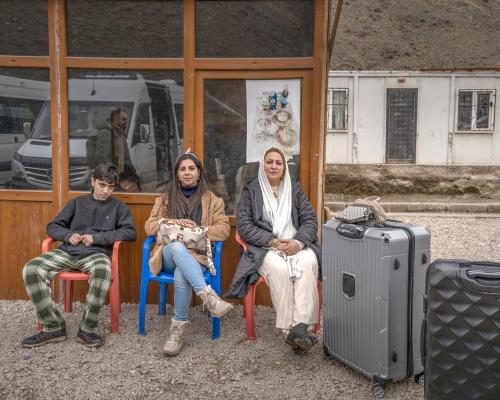
At the Kapıköy border crossing in eastern Turkey, Iranians are navigating a landscape of chaos and uncertainty as conflict intensifies back home. Amir, a 33-year-old foreign exchange and cryptocurrency trader who recently fled Tehran, succinctly captured the mood: "Every night they are bombarding." His words resonate with many who find themselves at this pivotal junction between war-torn Iran and the relative safety of Turkey.
Transforming Border Dynamics Amid War
The Kapıköy border point, nestled between snow-capped peaks, has transformed dramatically in recent weeks. Once a bustling hub for Iranian day-trippers visiting Turkey for shopping and nightlife in the nearby city of Van, it is now a passageway for those escaping the escalating violence. Until recently, the border saw a steady stream of visitors, but the recent military actions have shifted the dynamics significantly. A month ago, the Iranian regime raised a black flag following the death of Supreme Leader Ali Khamenei, a stark reminder of the current turmoil. Originally reported by The Guardian.
Amir's decision to leave was spurred by the relentless bombings shaking Tehran. "I hope [the bombing] is working," he said, referring to the ongoing military operations. "Nearby cities, industrial areas and military bases, completely destroyed." The Iranian regime's internet blackout has compounded the crisis, leaving Amir without a means to earn a living. "No internet, no job," he lamented, illustrating the dire situation that many are facing.
Mixed Motives: Some Flee, Others Return
The UN refugee agency (UNHCR) reports that approximately 64,000 Iranians entered Turkey between March 3 and March 30, while over 48,000 returned to Iran. This ebb and flow of movement suggests a complex reality; not all are fleeing in desperation. Many are choosing to return, driven by a mix of necessity and hope. "The current volume of movement remains notably lower than pre-conflict levels," a UNHCR spokesperson stated, emphasizing that daily crossings previously averaged about 5,000 individuals.
Among those returning is a pharmacologist from Tehran, who is headed to Europe to visit her daughters. "All of the people live with anxiety," she expressed, reflecting a shared sentiment among many Iranians. She noted, "I don't like Trump, but it is right this time for the Iranian people. We are very tired about the revolution of [the] Islamic Republic of Iran." The hope for change resonates strongly, and many view the current tumult as a potential turning point.
Humanitarian Preparations and Economic Impact
Turkey is bracing for a possible influx of refugees, with plans to establish tent cities for up to 90,000 people if necessary. Currently, the situation has not reached that critical threshold, but the presence of heavily armed soldiers maintaining security along the route to Van underscores the seriousness of the situation. Salvador Gutiérrez, chief of mission in Iran for the International Organization for Migration, noted that many are moving internally within Iran, particularly to regions near the Caspian Sea.
Despite the war, economic challenges are becoming increasingly pronounced. Muhammed, a 42-year-old travel business owner, articulated the plight faced by many: "I have had to completely close the offices. I have said to my staff to go and just rest for minimum two months." The bombings have significantly disrupted daily life. "Our house is near to the airport. Each night you hear the big noises. More than a hundred times we have had bombings." The psychological toll is immense, with many adapting to the nightly chaos.
The Future Remains Uncertain
As the conflict continues, the humanitarian crisis deepens. The International Organization for Migration estimates that over 82,000 residential units have been damaged by the ongoing military strikes, impacting around 180,000 people. Access to essential services like electricity and water is becoming increasingly unreliable, prompting fears of further displacement. Gutiérrez cautioned that if access to basic needs continues to deteriorate, it could trigger more significant migration.
For many Iranians, the ongoing conflict represents both a danger and a glimmer of hope. The desire for change runs deep, and sentiments towards figures like Donald Trump have shifted as people cling to the hope that international pressure might bring about necessary reforms. As Amir poignantly noted, "The war is not good," yet for some, it may be the catalyst for long-awaited change.
Originally reported by The Guardian. View original.