
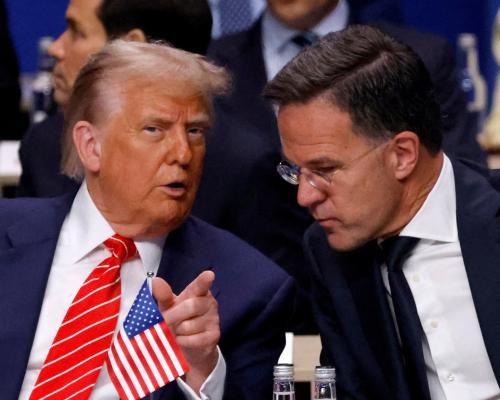
Concerns regarding the United States' commitment to NATO continue to reverberate across Europe following former President Donald Trump's recent comments about the alliance. During a private lunch that was briefly live-streamed before being removed, Trump raised eyebrows by questioning NATO's reliability in times of crisis, stirring worries among European leaders about America's role in global security.
As Trump spoke, Lithuanian prosecutor general Nida Grunskienė announced she would seek legal assistance from the U.S. in an ongoing pre-trial investigation into potential human trafficking offenses related to Jeffrey Epstein's released correspondence. This investigation, initiated in February, has drawn the attention of several Central and Eastern European countries, with Latvia and Poland launching their inquiries into the matter as well. Originally reported by The Guardian.
Trump's Controversial NATO Remarks
Trump's comments, made at a private event, included pointed criticisms of NATO, which he labeled a "paper tiger." He expressed skepticism about the alliance's effectiveness, specifically referencing the Iran war as evidence that NATO partners may not be reliable allies during significant conflicts. "If we ever have the big one - hopefully we won't, [our] relationship is very good with the big one, better than with NATO - but they won't be there," Trump stated. The vagueness surrounding who he referred to as "the big one" left many puzzled and concerned.
This is not the first time Trump has cast doubt on NATO's value. In recent speeches, he has criticized what he perceives as the failure of allies to contribute adequately to collective defense efforts. The lack of clarity about the U.S. commitment to NATO under his administration has many in Europe on edge, especially given the increasing tensions with Russia and China.
European Reactions and Ongoing Investigations
In the wake of Trump's remarks, Grunskienė emphasized the importance of gathering information regarding the potential human trafficking links to Epstein's associates. "Information is being gathered and analyzed, and we are preparing to send a request for legal assistance to the United States," she said during a press conference. To date, about 20 individuals have been interviewed, but no victims have been identified, according to Lithuania's public broadcaster LRT.
The inquiry's implications extend beyond Lithuania, as both Latvia and Poland have initiated separate investigations into similar concerns. The interconnectedness of these inquiries highlights the broader impact of Epstein's case on the region, raising fears about human trafficking networks potentially operating within Central and Eastern Europe.
Future of Transatlantic Relations
The uncertainty surrounding Trump's views on NATO poses a significant challenge for transatlantic relations. While he did not mention NATO during his prime-time address to the nation, which focused on the ongoing conflict in Iran, the underlying tensions remain palpable. Trump's failure to include NATO in his remarks has led to speculation about whether he will maintain the alliance's significance in U.S. foreign policy if he returns to power.
Ruth Deyermond, a senior lecturer at King's College London, suggests that the issues facing NATO are not solely a product of Trump's presidency. "This is wishful thinking," she noted on Bluesky, addressing the broader implications of disregarding the alliance's importance for U.S. security and taking allies for granted. She believes that the crisis will persist, regardless of who occupies the White House.
Legal Assistance and International Cooperation
As Lithuania prepares to engage with U.S. authorities for legal assistance, the ongoing investigations into human trafficking illustrate the complexities of international cooperation. The involvement of multiple countries in inquiries related to Epstein reflects a collective effort to address serious allegations that may extend beyond national borders. The situation underscores the need for collaborative frameworks to address such issues effectively.
In broader terms, the discussions around Trump's NATO comments and the human trafficking investigations point to the evolving landscape of international relations. As European leaders navigate these challenges, the region's reliance on the U.S. for security assurances remains precarious. The upcoming visit of NATO Secretary General Jens Stoltenberg to Washington may provide further clarity on the alliance's future and the U.S. commitment to its European partners.
Originally reported by The Guardian. View original.