
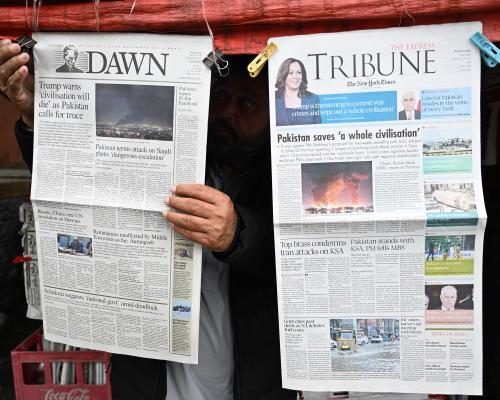
In a dramatic turn of events, a two-week ceasefire was announced on Tuesday, just before a deadline set by former President Donald Trump for Iran to reopen navigation through the Strait Of Hormuz. This decision follows weeks of escalating hostilities, including US and Israeli strikes against Iran and Iranian retaliation across the region. While leaders around the globe expressed relief at the announcement, uncertainty looms over the ceasefire's longevity and effectiveness.
Mixed Signals from Tehran and Jerusalem
Despite the ceasefire, tensions persist. Israel continues its offensive in Lebanon, a conflict Trump has labeled as separate from the ceasefire agreement, a characterization that Iran disputes. The Israeli assault has been devastating, resulting in at least 254 fatalities and 837 injuries, marking one of the largest strikes since its conflict with Hezbollah began. Trump has taken to social media to warn that if Iran does not comply with what he calls "the real agreement," the military response will be "bigger, and better, and stronger than anyone has ever seen before." This rhetoric raises questions about the actual terms of the ceasefire and whether it was a genuine agreement or merely a temporary pause. Originally reported by The Guardian.
Interpreting the Ceasefire Agreement
The ceasefire's specifics remain unclear, raising concerns about its viability. Peter Beaumont, a senior international correspondent for the Guardian, describes the agreement as "half-baked," suggesting it lacks the detailed verification mechanisms necessary for a sustainable ceasefire. Beaumont points out that typically, a meaningful ceasefire includes trust-building measures and clear principles. Instead, what was presented seems more like a hastily assembled set of principles, with both sides already showing signs of buyer's remorse.
Adding to the confusion, U.S. Defense Secretary Pete Hegseth indicated that the U.S. would seize Iran's uranium if it wasn't handed over, contradicting the Farsi version of the deal that included terms for Iran's nuclear program. This dissonance underscores the significant communication gap between the involved parties and could jeopardize the fragile pause in hostilities.
Consequences of Recent Military Campaigns
The military actions taken by the U.S. and Israel have undeniably shifted the regional dynamics, but whether these changes will lead to a lasting peace is debatable. Beaumont notes that while Iran has suffered substantial losses, including damage to infrastructure and leadership, the overall balance of power in the region has not fundamentally altered. The ongoing conflict has resulted in thousands of casualties and has drained resources, yet it remains to be seen if any side has achieved a strategic advantage.
"Wars are fought on human capital as much as technological capital," Beaumont argues, suggesting that despite the high-tech weaponry used, the human cost of these conflicts may ultimately determine their outcomes. As the ceasefire holds-at least for now-one must ponder whether it represents a step toward a more stable future or merely a brief respite from ongoing violence.
What Lies Ahead in the Middle East?
The immediate future is uncertain as both Iran and the U.S. navigate the complexities of the ceasefire. The coming days will be critical; the key question remains whether the truce can withstand scrutiny as unresolved issues linger, including Iran's nuclear ambitions, sanctions, and the freedom of navigation in the Strait of Hormuz. Beaumont emphasizes the lack of a coherent framework for assessing expectations, highlighting the varying interpretations of the ceasefire by different stakeholders, including the mediators.
The geopolitical implications of this ceasefire extend beyond the immediate actors involved. As the UK, represented by Keir Starmer, pledges to help reopen the Strait of Hormuz, the global economic consequences could be significant. Reports suggest that oil prices have dropped following the Ceasefire Announcement, indicating that markets are reacting to the hope of reduced tensions. However, should the ceasefire unravel, the repercussions for the global economy and regional stability could be dire.
As the world watches closely, the pivotal question remains: will this ceasefire hold, or is it merely a pause before the next phase of conflict? The coming weeks will reveal whether diplomacy can take root in a region defined by strife and uncertainty.
Originally reported by The Guardian. View original.