
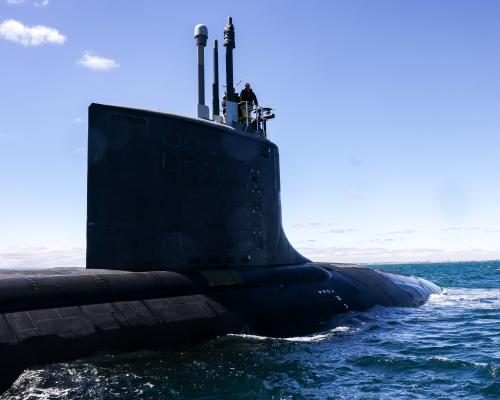
Australia's ambitious nuclear submarine program under the Aukus agreement is encountering significant financial overruns and production delays, raising doubts about the timely delivery of promised Virginia-class submarines. This week, the US Navy revealed it would not ramp up its submarine production to meet Australia's needs until 2032, a timeline that could jeopardize the entire initiative.
Rising Costs and Financial Commitments
The Australian government has made substantial financial commitments to bolster the Aukus agreement, recently adding an extra $400 million to its budget over the next three years. This brings the total funding for the Australian Submarine Agency to $2.13 billion through mid-2029. In addition, Australia has already allocated A$2.76 billion (approximately US$2 billion) to support the US submarine industry and A$863 million (£469 million) to assist the UK's submarine-building efforts. Originally reported by The Guardian.
Despite these investments, the total estimated cost of the Aukus deal has ballooned to A$368 billion (around US$232 billion) by 2055. This figure underscores the significant financial burden Australia is taking on, as the country seeks to modernize its naval capabilities amidst increasing geopolitical tensions.
US Production Delays Raise Concerns
The US Navy's admission that it will take until 2032 to produce two Virginia-class submarines per year serves as a stark warning for Australia. This production rate is still insufficient to meet the needs of both the US Navy and Australia's requirements. According to the Congressional Research Service, the US Navy currently possesses only 49 of the 66 submarines it deems necessary for its operations.
Historically, US shipyards have struggled to maintain production rates. While they once built submarines in six years, that timeline has now stretched to a full decade. Over the past 15 years, the US Navy has aimed to order two Virginia-class submarines annually, but actual production has been limited to approximately 1.1 to 1.2 boats per year. This growing backlog presents a significant hurdle for fulfilling foreign orders, including Australia's.
Challenges Facing US Shipbuilding
Admiral Daryl Caudle, the chief of naval operations, testified before the House Appropriations Committee defense subcommittee this week, indicating that while progress is being made, challenges remain. He noted, "I just got back from Perth, they're making their milestones. There's a couple things they're behind on, I'm frustrated with, that are part of the support system there."
However, even if production rates improve to two submarines per year, this would still fall short of the 2.33 boats per year required to fulfill Aukus commitments. The legislation governing the deal states that the US president can only transfer submarines to Australia if it does not compromise US undersea capabilities, adding another layer of complexity to the situation.
Structural Issues in Shipbuilding Industry
Moreover, the US shipbuilding industry faces ongoing structural challenges that could further delay the Aukus program. A recent report highlighted that workforce shortages are a major impediment to production rates. Many shipyards are struggling to hire and retain skilled workers as a generation of experienced employees retires. This has led to a less experienced workforce, which could hinder the timely construction of submarines.
Additionally, up to 70% of suppliers for critical submarine components lack competition, meaning that the failure of a single supplier could significantly disrupt production timelines. The Navy's recently released 30-year shipbuilding plan does not include provisions for additional submarines under the Aukus agreement, mentioning it only once as a footnote.
The challenges presented by the US submarine production delays and structural issues highlight the precarious nature of Australia's nuclear submarine ambitions under the Aukus agreement. As Australia invests heavily in its defense capabilities, the uncertainty surrounding the actual delivery of these assets raises serious questions about the viability of the program.
Moving forward, the Australian government will need to closely monitor developments in US submarine production and consider alternative strategies to ensure that its maritime defense objectives are met. With geopolitical tensions rising in the Indo-Pacific region, the urgency for Australia to secure its nuclear submarine capabilities has never been greater.
Originally reported by The Guardian. View original.