
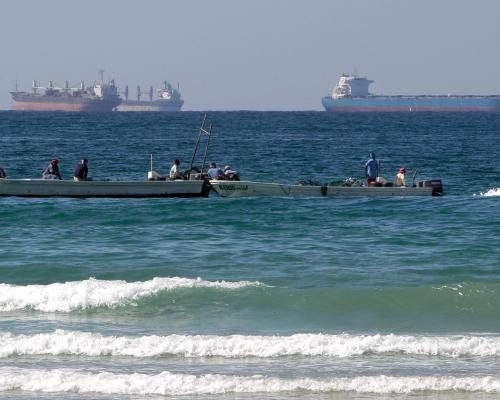
An unsettling silence has descended over Ras Al Khaimah's industrial port in the United Arab Emirates, a normally bustling maritime hub now rendered dormant. Ships are docked and eerily still, while hundreds of tankers linger just beyond the horizon, paralyzed by the looming threat of conflict. The strait of Hormuz, which lies only 20 nautical miles from Ras Al Khaimah, has transformed into one of the world's most perilous maritime passages. This week, two oil tankers were struck by Iranian missiles, highlighting the heightened volatility of the region.
On Saturday, the UAE's main oil port in Fujairah came under drone attack, thick smoke pluming from its terminal-a stark reminder of the many challenges Gulf states face as they find themselves ensnared in a war they did not instigate. Historically, Bahrain, Kuwait, Saudi Arabia, the UAE, Qatar, and Oman have maintained military partnerships with the United States, hosting bases and procuring advanced weaponry. However, the current conflict has led to mounting frustrations about the reliability of that alliance. Originally reported by The Guardian.
Gulf States' Response to Unprovoked Aggression
The perceived Iranian threat to the Gulf escalated significantly following the U.S. declaration of war, a sentiment echoed by Khaled Almezaini, an associate professor of politics and international relations at Zayed University in Abu Dhabi. "The perceived Iran threat to the Gulf only became a reality when the US declared the war - Iran did not fire first," he stated. Despite widespread condemnation of Iran's actions, there's a growing desire among Gulf leaders to find a resolution to the hostilities.
In the weeks leading up to the recent strikes, Gulf leaders made diplomatic overtures to the U.S. administration, warning of the severe repercussions for regional stability should military action be taken against Iran. Yet, analysts suggest that President Donald Trump proceeded without consulting these allies, leading to fears that the Gulf states would bear the brunt of the fallout. The scale of Iran's retaliatory measures has left many shocked; thousands of drones and missiles have targeted critical infrastructure, including airports and oil refineries.
Economic Fallout and Military Challenges
The ongoing conflict has severely disrupted aviation in the region, with airlines facing staggering losses amounting to billions of dollars. Bahrain is grappling with an economic crisis, while the UAE's image as a tourist haven and investment hotspot is at risk. Although Gulf states have successfully intercepted many Iranian missiles and drones, the cost of air defense systems has surged, with the UAE reportedly spending upwards of $2 billion to bolster its defenses.
Moreover, Iran's blockade of the strait of Hormuz, through which nearly one-fifth of global energy supplies transit, has led to a staggering loss in oil and gas exports. Experts estimate that the Gulf economies are losing between $700 million and $1.2 billion daily due to these disruptions. The dire economic implications further complicate the already tense geopolitical landscape.
Changing Dynamics of Regional Alliances
The asymmetry of the Gulf's military partnership with the U.S. has never been more evident, according to Allison Minor, director of the Atlantic Council's project on Middle East integration. The Gulf states are questioning whether they receive the level of security support necessary in light of recent events. Minor highlighted that Israel's airstrikes on Qatar, another U.S. ally, did not elicit a significant response from Washington, raising concerns about the reliability of American backing.
Oman's foreign minister, Badr bin Hamad al Busaidi, recently voiced strong opposition to U.S. Military Actions against Iran. He characterized these strikes as illegal and suggested that continuing hostilities breach international law. Al Busaidi argued that the U.S. decision to strike while diplomatic negotiations were underway indicated a move to reorder the Middle East in favor of Israel, a point of contention among Gulf states.
The situation remains precarious as Gulf nations navigate the intricate balance of de-escalating tensions while advocating for a decisive end to the conflict. As they seek to protect their sovereignty and economic interests, the stakes have never been higher.
Originally reported by The Guardian. View original.