
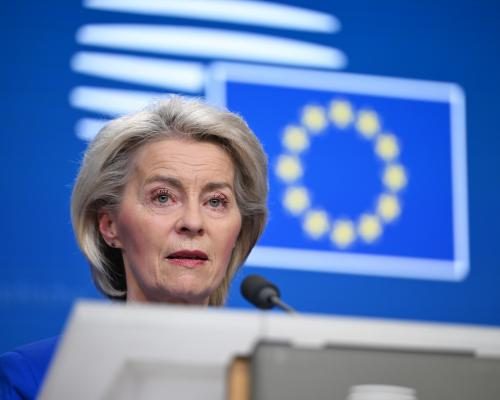
European Commission President Ursula von der Leyen reaffirmed the European Union's commitment to disburse a crucial €90 billion ($104.2 billion) loan to Ukraine, despite ongoing resistance from Hungary. "We will deliver one way or the other," von der Leyen stated to reporters following a summit in Brussels where EU leaders failed to persuade Hungarian Prime Minister Viktor Orbán to lift his blockade on the financial support necessary for Ukraine's defense against Russian aggression.
Hungary's Persistent Resistance
Hungary's Prime Minister Viktor Orbán has long been an ally of Moscow within the EU, often obstructing measures aimed at supporting Ukraine. His government has consistently stalled EU aid and sanctions against Russia, which complicates the bloc's efforts to present a united front. During the recent summit in Brussels, EU leaders engaged in extensive discussions with Orbán, but the talks did not yield the desired results, leaving the status of the vital loan in limbo. This refusal to cooperate highlights the tensions within the EU, where differing national interests can hinder collective action. Originally reported by The Guardian.
The €90 billion loan is essential for Ukraine, particularly as it navigates ongoing military conflict with Russia. The funding is intended to bolster the nation's war effort and support its economy, which has been severely impacted by the invasion. With Hungary's blockade in place, EU officials are exploring alternative means to ensure that the financial aid reaches Kyiv promptly.
International Responses and Negotiations
As geopolitical tensions continue to escalate, recent developments have also seen the Kremlin commenting on the state of negotiations aimed at resolving the conflict in Ukraine. On Thursday, Russian officials indicated that talks among Washington, Moscow, and Kyiv regarding a potential peace settlement were on a "situational pause." This was attributed to the recent outbreak of conflict in Iran, which has further complicated the already intricate diplomatic landscape. Nevertheless, Ukrainian President Volodymyr Zelenskyy indicated that new discussions are anticipated this weekend, as Ukrainian and U.S. negotiators are scheduled to meet in the United States.
This diplomatic engagement underscores the urgency surrounding the war, with both sides seeking a resolution while grappling with escalating tensions. The ongoing talks will be crucial for shaping the future of Ukraine and ensuring its sovereignty against Russian advances.
IMF Engagement in Ukraine
In tandem with the EU's efforts, the International Monetary Fund (IMF) is actively engaging with Ukrainian authorities this week. IMF staff are set to discuss how Ukraine can meet its obligations under a newly approved $8.1 billion lending program. This program is vital for stabilizing Ukraine's economy, especially amid the ongoing conflict and the pressing need for fiscal reforms.
IMF spokesperson Julie Kozack highlighted that discussions will also involve members of the Ukrainian parliament to address necessary tax changes and fiscal reforms required under the program. The engagement of international financial institutions is critical for Ukraine as it seeks to navigate the financial repercussions of the war and maintain economic stability.
Additional Global Developments
On another front, Belarusian President Alexander Lukashenko announced the release of 250 political prisoners, a move seen as an effort to mend ties with the West following a meeting with U.S. officials. This decision came after discussions with John Coale, a special envoy for Belarus to the U.S. The Belarusian leader's actions may signal a shift towards greater diplomatic engagement, although skepticism remains regarding his intentions.
As the humanitarian crisis unfolds in Ukraine, the International Committee of the Red Cross reported that it facilitates the exchange of approximately 1,000 bodies each month between the conflicting sides. The organization stated that "thousands and thousands" of deceased individuals remain unidentified, emphasizing the human cost of the ongoing war. Pierre Krahenbuhl, director-general of the Red Cross, expressed his concern over the severe consequences arising from the conflict.
While the situation remains fluid, the EU's commitment to supporting Ukraine is unwavering. Despite internal challenges, leaders are determined to find a way to deliver the necessary aid. The potential for renewed negotiations between Kyiv and Moscow adds another layer of complexity to the situation, as the international community watches closely.
Originally reported by The Guardian. View original.